Know Your Mangoes
Forty varieties. Thirteen weeks. One country’s summer.
Generated by Imagen 4
Seven thousand seven hundred rupees. Two dozen mangoes. Three hundred and twenty rupees per fruit.
This is not a price. This is a confession.
Bombay paid it on January 15, 2024. The first auction of the season. Twenty-four mangoes, taped in a petis, walked out of Crawford before most of us had said the word aam out loud this year.
The buyer knew what they were paying for. This is what that was.
THE FOUR-THOUSAND-YEAR SECRET
The mango is older than most of what we call India.
The Sanskrit word is amra. Four thousand years ago, somewhere in the foothills between Myanmar and Northeast India, people began keeping one wild tree and leaving the rest. Every Alphonso, every Kesar, every Dasheri, every roadside kairi sold in a newspaper cone — all of it traces to that first patient yes.
The Ramayana has mangoes in it. Buddhist monks ate them under the trees they sat under. Mughal emperors built gardens for them — not grounds, gardens — with gardeners who had titles. The Dasheri is a variety first cultivated in a royal orchard in Lucknow in the 1800s. It is still sold on the same pavements today.
Every argument about mangoes is an argument about patience.
THE PORTUGUESE PLOT TWIST
The Alphonso, the hapus, the fruit we have entire summer WhatsApp groups for, carries a Portuguese name. Afonso de Albuquerque. The commander who took Goa for Lisbon.
The Portuguese did not bring the mango. India had it by about three and a half thousand years. What they brought was grafting — old-world horticultural technique. Somewhere in sixteenth-century Goa, that technique met Indian rootstock and a new fruit took shape. Smaller, sweeter, and impossibly consistent.
Every grove in Ratnagiri, every tree in Devgad, every crate of hapus that arrives in the city between March and June descends from that grafting.
THE KONKAN IS THE COUNTRY
The Konkan coast — Ratnagiri, Devgad, and the villages between — is where hapus is grown. The soil is red, lateritic, and the sea wind matters.
Ratnagiri and Devgad are siblings. Same coast, same tree line, same varietal. Around three days separates one harvest from the other. That small window, in a fruit this temperamental, is the difference between a fine box and a memorable one.
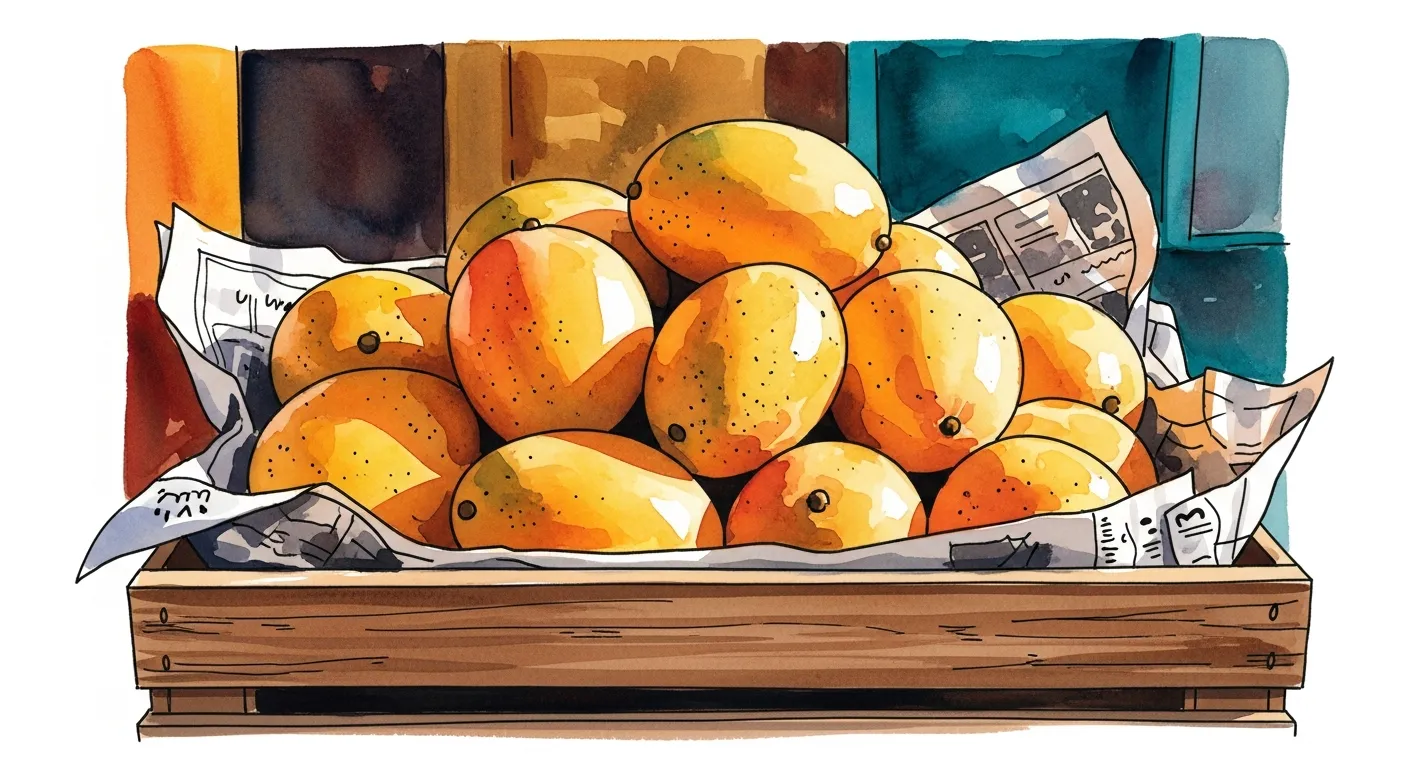
The boxes themselves are wooden, taped shut, twenty-four fruits to a petis, wrapped in newspaper that rustles when you lift the lid. It is always a lift, never a tear.
HOW TO ACTUALLY BUY ONE
Colour is the least useful signal. Mangoes ripen from the inside out. A green Alphonso can be ready. A bright yellow Kesar can be already past.
Press gently at the shoulder. It should give. Not feel soft — just give.
Smell the stem end. A ripe mango smells like itself. If it smells like alcohol, it has gone further than you want. If it smells like nothing, it has not arrived.
Price is the second-best signal. Premium fruit is hand-picked, wrapped in paper, and driven overnight. The extra rupees sit in the truck, the packing, and the hands that did the picking — not in the vendor's margin.
The colour is the lie. The stem is the truth.
THIRTEEN WEEKS
That is the whole season. Mid-March to mid-June. Thirteen weeks of summer held in a fruit.
April is the peak. Supply floods, and a good Alphonso can drop under a thousand rupees a dozen. For a few weeks, the city eats mangoes properly — on trains, at desks, over kitchen sinks, in cars at traffic lights with the window down.
By June, the late varieties show up. Amrapali, Mallika, Neelam. Cheaper, quieter, and often some of the most honest fruit of the year. Then the first real monsoon rain hits. One strong shower and the sugar flattens. The tree knows. The season ends.
If you have not eaten your share by the middle of June, you have missed it.
BACK TO THE RANSOM
Three hundred and twenty rupees a fruit is not expensive. It is exact.
It pays for twenty-four mangoes hand-picked in Ratnagiri, packed under supervision, and driven through the night. It pays for four thousand years of farmers selecting one tree and walking past another. It pays for a Portuguese ship, a Mughal gardener, and an orchard outside Lucknow in 1801. It pays for the people who still do this work with real hands every summer.
That fruit did not cost three-twenty. It cost all of that. The market simply let the buyer pay in cash.
THE MANGO MATRIX
Every variety is a region that spent a century making up its mind. Every price is soil, time, and the distance to the market.
Maharashtra
Alphonso · Ratnagiri Rich, creamy, saffron notes. April–May. Rs 800–1,500.
Alphonso · Devgad Buttery, intensely sweet. April–May. Rs 1,000–1,800.
Rajapuri · Pune Large, sweet, generous. May. Rs 350–550.
Bombay Green · Pune Tangy, for cooking. March–April. Rs 200–350.
Gujarat
Kesar · Junagadh Sweet, aromatic, firm. May–June. Rs 600–900.
Gir Kesar · Gir Intense kesar punch. May. Rs 800–1,200.
Sindhu · Valsad Sweet, aromatic. May. Rs 450–700.
Uttar Pradesh
Dasheri · Malihabad Delicate, very low fibre. May–June. Rs 500–700.
Chausa · Hardoi Sweet-tart balance. June–July. Rs 400–650.
Langra · Varanasi Tangy-sweet, firm texture. June–July. Rs 400–600.
Safeda · Lucknow Mild, pale flesh. June. Rs 350–500.
Dussehri · Lucknow Aromatic, sweet. June. Rs 450–650.
Goa
Mankurad · South Goa Small, intensely sweet. April–May. Rs 800–1,200.
Fernandinho · North Goa Portuguese heritage, rich. April. Rs 700–1,000.
Karnataka
Totapuri · Tumkur Firm, tangy, a cooking variety. April–May. Rs 250–400.
Badami · Ramanagara Aromatic, almond notes. April–May. Rs 350–550.
Pairi · Kolar Mild, softer texture. March–April. Rs 300–450.
Malgova · Bangalore Sweet, firm, oval. May. Rs 400–600.
Andhra Pradesh
Banganpalli · Kurnool Large, sweet, low fibre. April–May. Rs 450–700.
Suvarnarekha · Visakhapatnam Golden, aromatic. April–May. Rs 500–750.
Imam Pasand · Cuddapah Large, sweet, a royal variety. May. Rs 600–900.
Neelam · Chittoor/Krishnagiri Mild, with a long shelf life. May–June. Rs 250–450.
Tamil Nadu
Salem · Salem Sweet, slightly fibrous. April. Rs 300–500.
Rumani · Coimbatore Rich, creamy. May. Rs 700–1,000.
Peter · Theni Sweet, firm. April–May. Rs 400–650.
Chandrakaran · Tirunelveli Aromatic, sweet. May. Rs 550–800.
Kerala
Muvandan · Kozhikode Traditional, tangy-sweet. April–May. Rs 400–600.
Priyur · Thrissur Sweet, soft pulp. May. Rs 500–750.
West Bengal
Himsagar · Murshidabad Deeply sweet. May–June. Rs 600–900.
Kishan Bhog · Nadia Rich, creamy texture. June–July. Rs 500–750.
Fazli · Malda Large, mellow, mild. July–August. Rs 300–450.
Bihar
Jardalu · Munger Small, intensely flavoured. June. Rs 500–800.
Zardalu · Bhagalpur Apricot notes. June–July. Rs 400–650.
Gulabkhas · Bhagalpur Rose-scented. June. Rs 350–550.
Amrapali · Darbhanga/Saharanpur Hybrid, balanced. June–July. Rs 300–500.
Mallika · Muzaffarpur Hybrid, aromatic. June. Rs 400–600.
Himayudin · Darbhanga Late-season, sweet. July. Rs 300–500.
Odisha
Bombai · Mayurbhanj Large, sweet. May. Rs 300–450.
Bangalora · Cuttack Aromatic, golden. May–June. Rs 400–600.
Subarnarekha · Balasore Golden, sweet. May. Rs 450–700.
Forty varieties. Eleven states. Each line is a region that made up its mind, over generations, about what a mango should taste like.
Field Notes
Quick referenceRs 7,700 for 24 Alphonso mangoes. Rs 320 per fruit. January 15, 2024.
4,000 years old. Sanskrit amra. One tree, one yes, every mango in India.
Alphonso named after Afonso de Albuquerque. European grafting, Indian rootstock.
Three days between harvests. Same coast, same wind. The line between fine and ridiculous.
Colour lies. Stem tells truth. Smell for alcohol or nothing.
Get the next story first
Join the Bhukkads. Free, no spam, just stories.
Takes 30 seconds.