The Promenade Ate the Pavement
A 5.5-kilometre stretch of reclaimed concrete is quietly dismantling a street food economy that nobody planned and everybody used.
Generated by Imagen 4
In 1675, Gerald Aungier, the Governor of Bombay, looked at the seven marshy islands under his administration and decided they needed more people. He invited weavers from Gujarat, Parsi merchants from Surat, and traders from the Konkan coast. He offered them land, freedom from tariffs, religious tolerance. The logic was simple. Infrastructure attracts bodies. Bodies attract commerce. Commerce attracts food. That sequence has not changed in 349 years. What has changed is who builds the infrastructure, and who gets to sell the food.
Worli Sea Face is not the subject of this story. Not yet.
THE ROAD THAT SWALLOWED A COASTLINE
The Mumbai Coastal Road is a 10.58-kilometre freeway connecting Marine Drive to the Worli end of the Bandra-Worli Sea Link. The project was sanctioned in 2011. Construction began in earnest around 2018. The southbound lanes opened to traffic in March 2024, the northbound lanes shortly after. The total cost is estimated at over Rs 12,000 crore.
But the road itself is not the disruption. The disruption is what sits on top of it.
A new 5.5-kilometre promenade, running along the Worli stretch, has been developed as part of the Coastal Road project. It features broad footpaths, cycle tracks, seating areas, green landscaping, and wheelchair-friendly ramps. Four pedestrian underpasses have already been opened, connecting the original Worli Sea Face road to this new waterfront. Two new parking lots, each with a capacity of 198 cars, are being constructed near Bindu Madhav Thackeray Junction and opposite Worli Dairy.
It is, by any civic standard, impressive. It is also a problem.
The promenade did not replace the sea face. It split the audience.
WHAT WORLI SEA FACE WAS

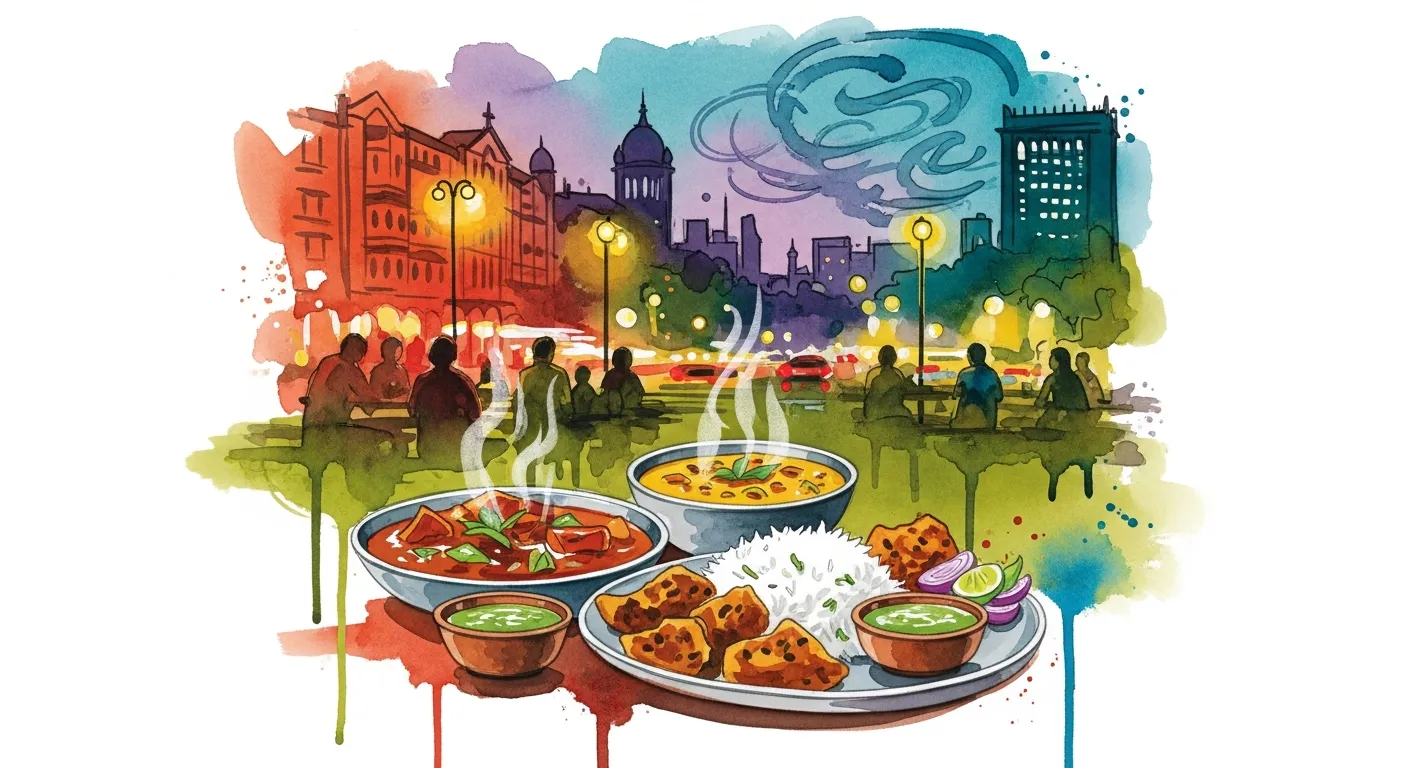
Before the concrete and the cycle tracks, Worli Sea Face was a classic sunset-watching spot lined with street food vendors. The stretch from Worli Village to the Sea Link was, for decades, a linear economy. You parked, or you walked from the bus stop. You stood at the tetrapods. You watched the sun go down. And between parking and sunset, you ate.
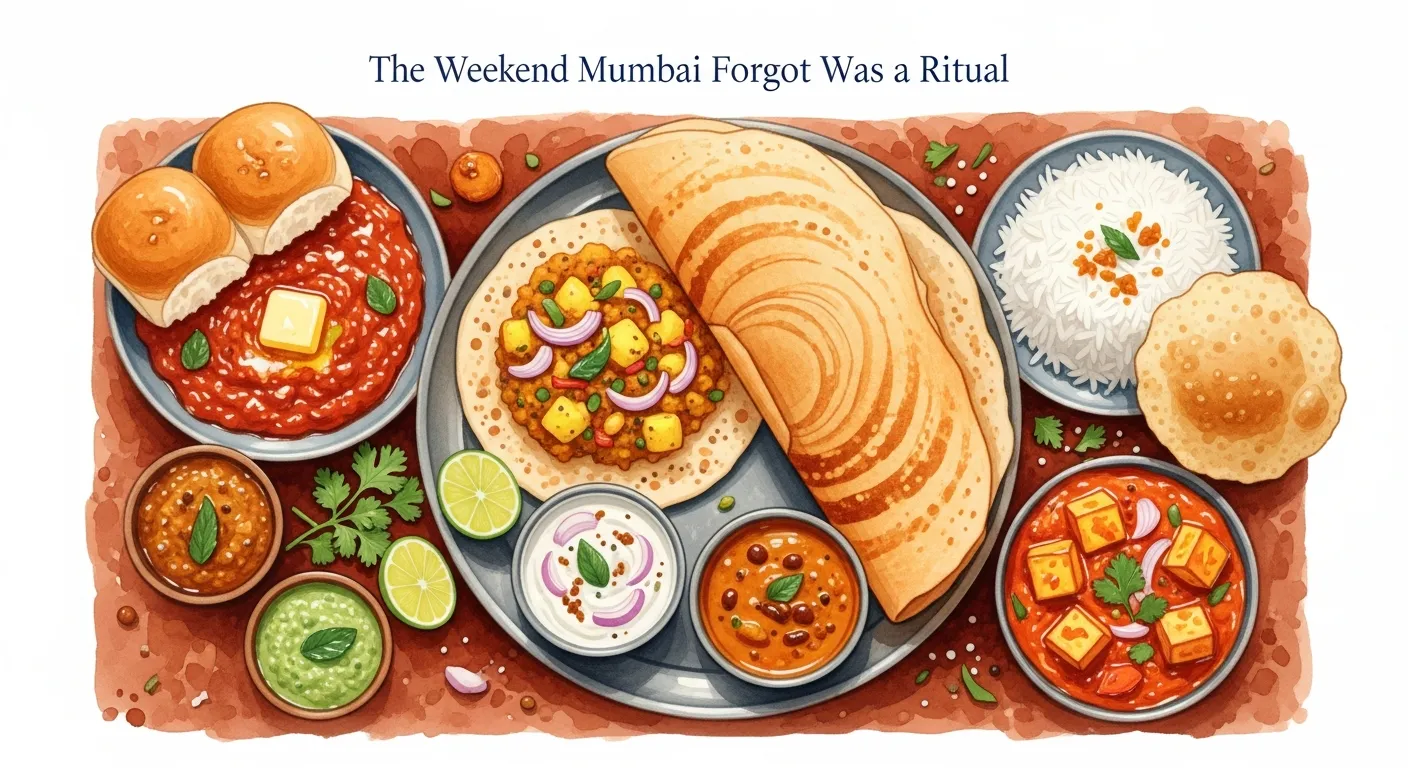
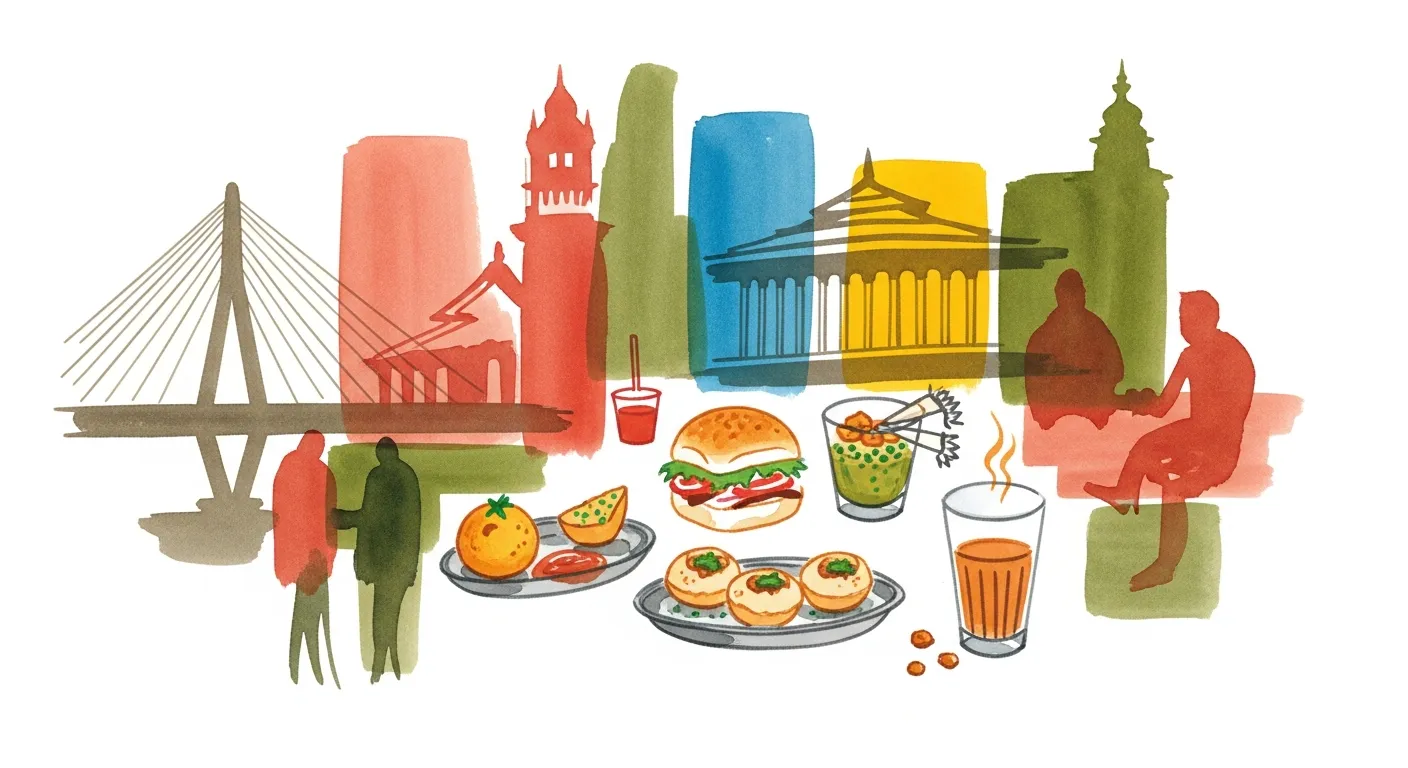
Bhel. Pav bhaji. Cutting chai. Corn on the cob, blackened over coal, rubbed with lime and chilli. Gola. Sandwiches pressed on portable grills. The vendors operated on a simple principle: the footpath was the storefront, the Arabian Sea was the ambiance, and the margin on a plate of bhel was thin enough that volume was the only business model that worked.
This was not a planned food district. Nobody issued licenses for a sunset economy. It was an emergent system, the kind that Robert Neuwirth has written about as characteristic of informal economies worldwide. Vendors positioned themselves based on foot traffic, negotiated with local authorities through a combination of hafta and persistence, and passed their spots down through families. A corner near the tetrapods was an inheritance.
Nobody talks about what the construction years did.
THE FIVE YEARS NOBODY COUNTED
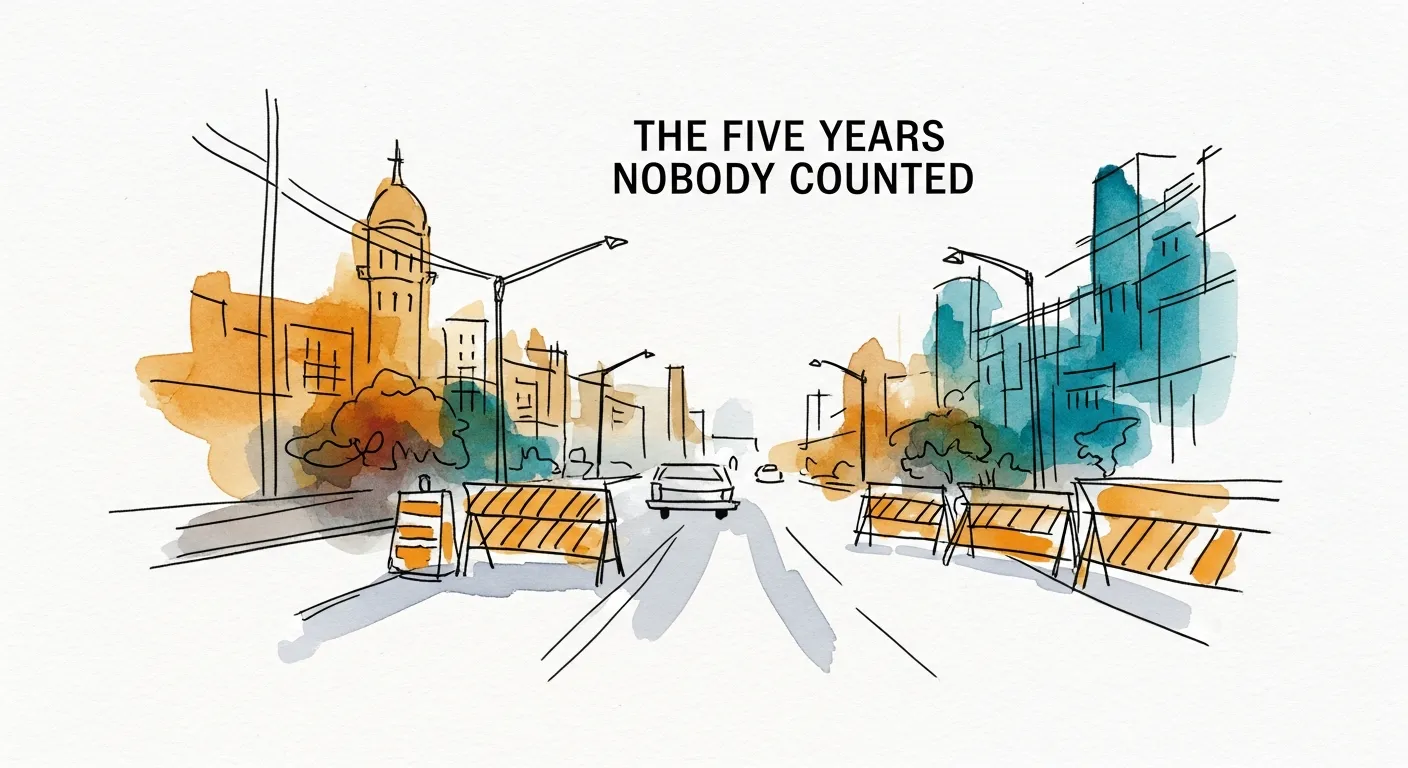
The Coastal Road construction effectively disrupted Worli Sea Face from roughly 2018 to 2024. Six years. Barricades. Diverted roads. Dust. Noise. The sunset was still there, but the walk to it was an obstacle course. Foot traffic dropped. Many vendors relocated, some to Dadar chowpatty, some to Mahim, some simply stopped.
A vendor who survives on a margin of Rs 3 per plate of bhel cannot survive six years of reduced foot traffic on savings. There are no savings.
The ones who stayed did so because they had nowhere else to go, or because they understood something fundamental about Mumbai: disruptions end. The sea stays.
The sea stays.
THE NEW GEOMETRY
Here is the problem the promenade creates, and it is a problem of geometry.
The old Worli Sea Face had one surface: the footpath along the road. Vendors set up on the road side. Customers walked to the sea wall. The transaction happened in between. Simple.
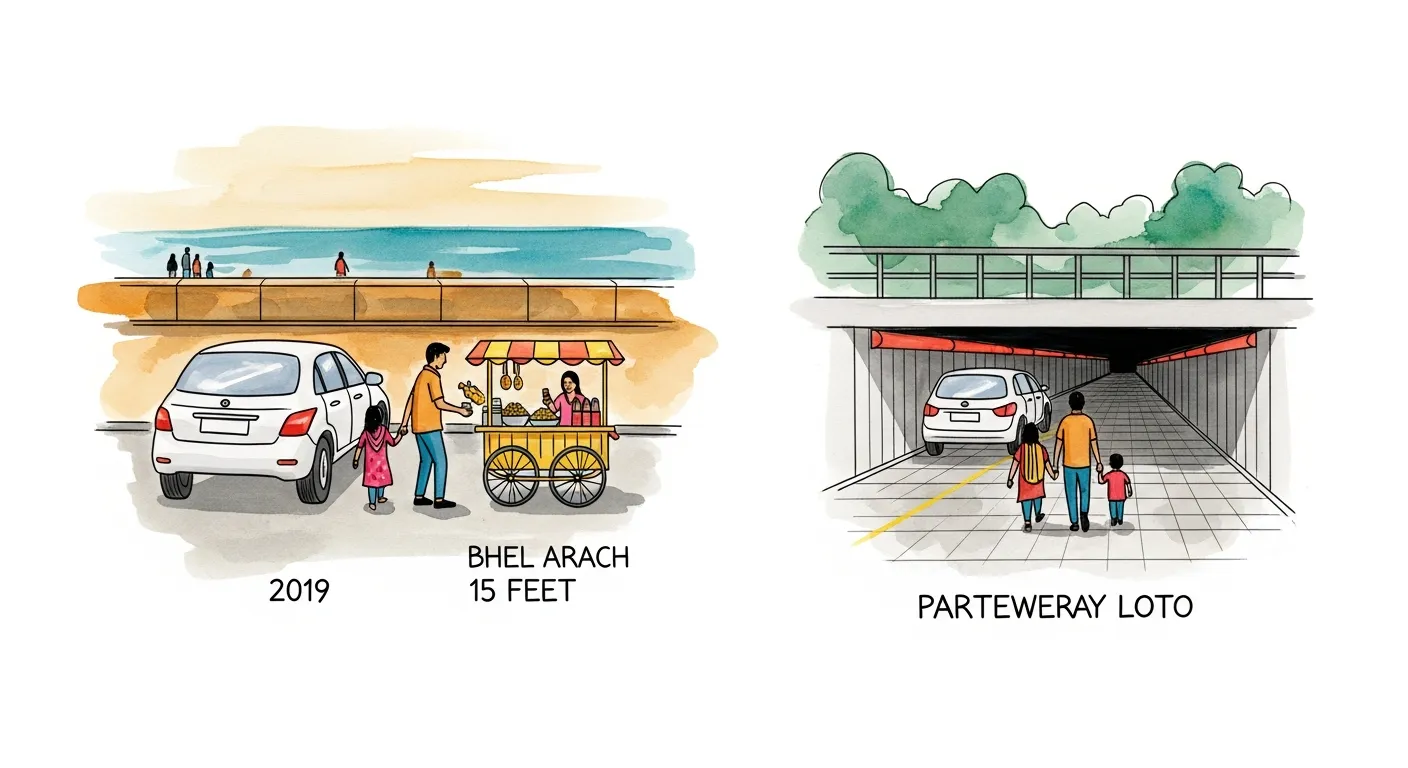
The new promenade is a second surface, lower, wider, and separated from the original road by underpasses. A person who parks at the new 198-car lot and descends through an underpass to the promenade may never walk along the old Sea Face road at all. They enter a new ecosystem. Cycle tracks. Benches. Landscaped green patches. The promenade is designed as a destination, not a transit corridor.
The vendors are on the old road. The foot traffic is on the new promenade. The underpass is not a connection. It is a border.
Think about that.
A family that drove to Worli Sea Face in 2019, parked on the road, bought bhel from a cart 15 feet from their car, and walked to the wall, now parks in a basement lot, walks through a tunnel, and emerges onto a promenade where there are no vendors. The bhel cart is 40 feet above them and on the other side of a six-lane road.
THE BMC'S ANSWER
The Brihanmumbai Municipal Corporation has not ignored this. In fact, they have a plan. The BMC has been considering the establishment of food hubs at locations including Worli Sea Face, permitting food trucks and stalls to operate on footpaths from 6 pm to 11 pm daily.
This sounds like a solution. It is not, entirely.
A food hub is a formalized zone with permits, time restrictions, and likely rental fees. The man who has been selling chai from a kettle balanced on a kerosene stove since 1998 does not operate in the food hub economy. He operates in the hafta economy. These are different worlds with different entry costs, different patrons, and different survival logics.
The food hub is designed for food trucks. The food truck is designed for Instagram. The Instagram customer is not the same person who used to eat bhel at the tetrapods at 7 pm on a Tuesday.
The BMC's plan will likely benefit a new class of vendor, one with the capital for a truck, the ability to navigate permits, and the aesthetic vocabulary to serve cold brew and loaded fries on a sea-facing promenade. The old vendor, the one with the kerosene stove and the cutting chai, is not being removed. He is being made irrelevant by architecture.
THE DEMOGRAPHIC SHIFT
The promenade is open 24 hours a day, 7 days a week. It has parking. It has ramps. It is, by design, accessible to a wealthier, car-owning demographic that previously might have gone to Bandra Bandstand or Carter Road for an evening walk. The cycle tracks attract a fitness crowd. The landscaping attracts families who want a controlled, clean environment.
None of these people are the core customer of a bhel vendor.
The old Worli Sea Face crowd was mixed. Office workers from Lower Parel walking over after a shift. Couples. College students from KC or Ruia taking the bus. Families from the BDD chawls. The vendor economy was calibrated to this crowd: low price, high volume, no frills.
The new promenade crowd wants something else. They want what Marine Drive's new restaurants offer, what Bandra's Bandstand has slowly become. The shift is not hypothetical. It is already happening.

Nobody planned the old economy. Nobody mourns it either.
WHAT ADAPTATION LOOKS LIKE
Some vendors are adjusting. The ones with slightly more capital are exploring the food hub route, looking at permits, considering whether a cart can be upgraded to a stall. Others are doubling down on the old road, betting that the underpasses work both ways, that some fraction of promenade visitors will surface for a plate of pav bhaji on the way back to their car.
A few are doing what Mumbai's street food economy has always done: following the feet. If the feet go down to the promenade, the vendor will find a way down to the promenade. It will not be legal, and it will not be permanent, and it will involve the same negotiation with the same authorities that has defined street vending in this city since Aungier invited the first merchants to fill his empty islands.
The question is whether the new infrastructure leaves room for that negotiation, or whether the underpasses and the parking lots and the cycle tracks have made the whole thing so legible, so planned, so visible, that the informal economy simply cannot operate in its cracks.
THE PATTERN
This has happened before. The mill lands of Lower Parel, when they became high-rises and malls, displaced an entire ecosystem of lunch vendors who fed mill workers. The Skywalk projects of the 2000s, meant to separate pedestrians from traffic, killed dozens of ground-level stalls by lifting customers 15 feet above the vendors who served them. The Metro construction along the Western Express Highway has done the same in Andheri and Goregaon.
Every infrastructure project in Mumbai produces a new map. And every new map erases someone who was reading the old one.
The Coastal Road promenade is the latest and most beautiful example. It is genuinely lovely. The cycle tracks are smooth. The seating is generous. The Arabian Sea, from this new elevation, looks spectacular.
But between the old pavement and the new promenade, there is a gap. It is only 40 feet and one underpass wide. For a vendor with a kerosene stove and a margin of Rs 3, it might as well be the ocean.
Aungier would understand. Infrastructure attracts bodies. Bodies attract commerce. Commerce attracts food. But only if the food is allowed to follow.
Field Notes
Quick referenceSix years of disruption. No savings survive that.
The underpass is not a connection. It is a border.
Rs 3 profit per plate of bhel. Volume is the only business model.
Food hubs are designed for Instagram. Kerosene stoves are not.
A corner near the tetrapods was passed down through families.
Get the next story first
Join the Bhukkads. Free, no spam, just stories.
Takes 30 seconds.