The Price of the Tawa
FSSAI's new compliance regime is quietly rewriting the economics of Bombay's most democratic meal.
Generated by Imagen 4
In 1966, the United States Congress passed the Fair Packaging and Labeling Act, requiring every food product sold in America to declare its contents, weight, and manufacturer on the label. The law was not aimed at factories. It was aimed at trust. The idea was simple: if people know what they are eating, they will make better choices. Within a decade, the cost of compliance had killed 40% of small-batch producers in three states. The people who could least afford transparency were the ones asked to pay for it first.
This is not an American story. This is a Tardeo story.
THE PLATE THAT BUILT A PAVEMENT
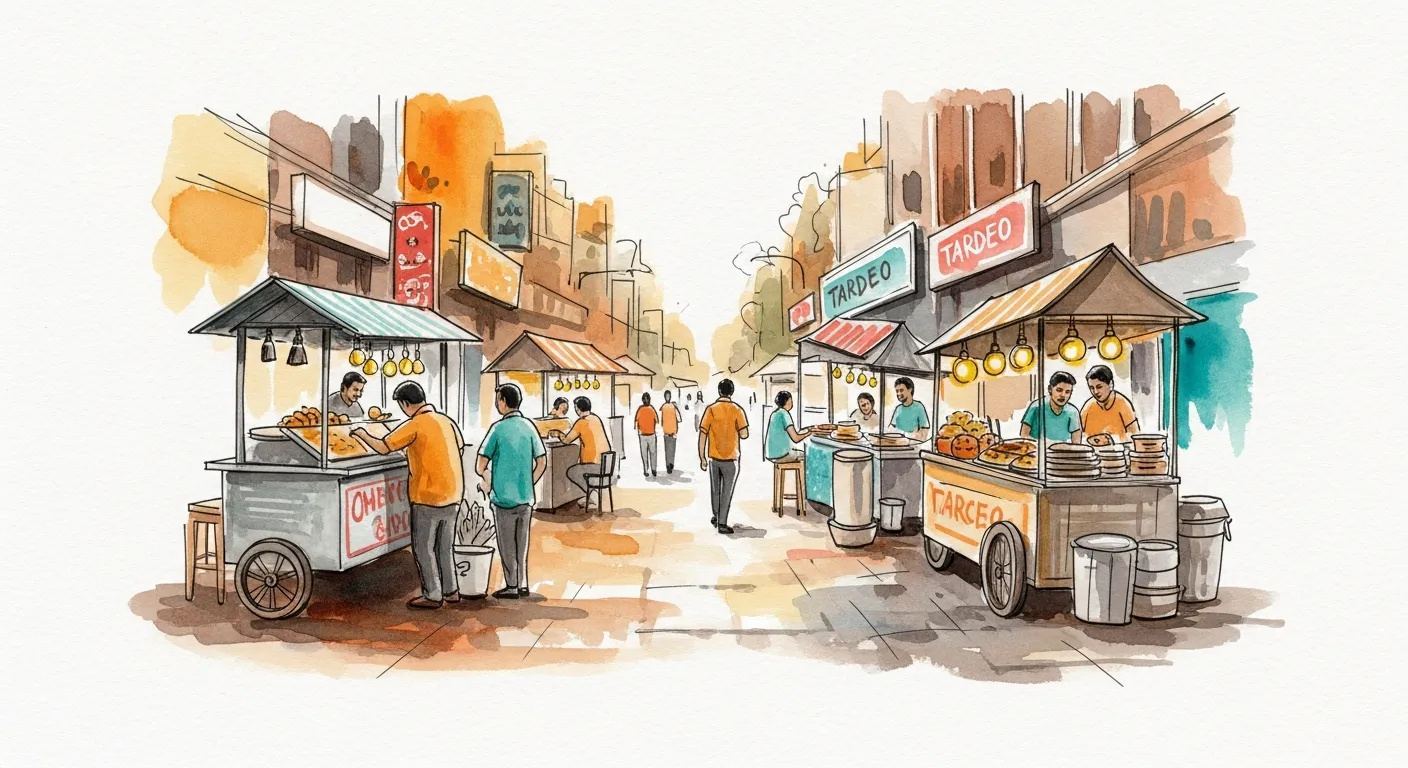
If you have eaten pav bhaji in Bombay, you have an opinion about Tardeo. Specifically about the stretch near Sardar Pav Bhaji, the stall that has operated on Tardeo Road since 1971. The place does not need an introduction. It needs a crowd-control strategy. On any given weekend night, the queue wraps past the signal. The butter is visible from across the street, not as a garnish but as a geological layer. A plate costs you somewhere between 150 and 200 rupees depending on what you order and how much cheese your conscience permits.
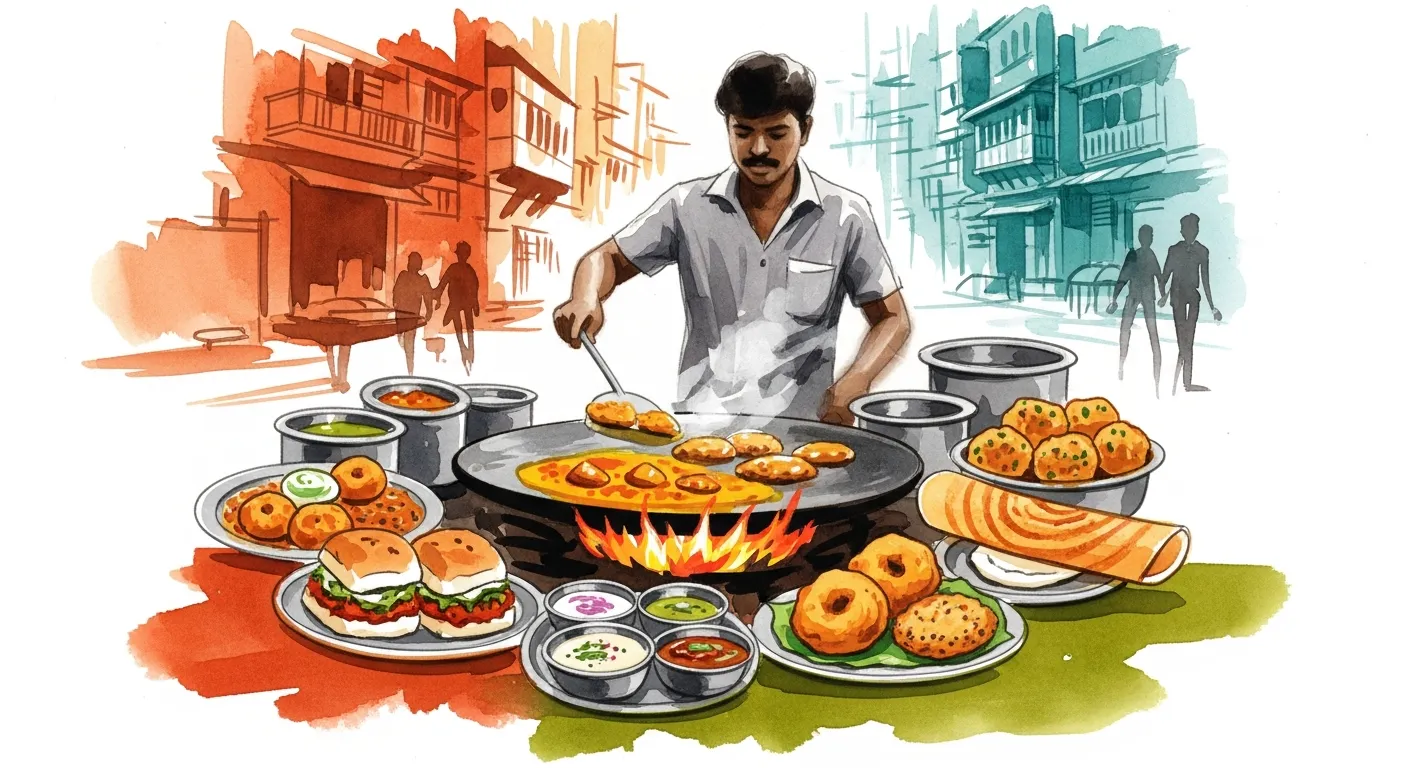
Around Sardar, a constellation of smaller stalls has operated for decades. Some with names. Some without. Some with the same family running the tawa for three generations. These are not restaurants. They are not even establishments in the way the Food Safety and Standards Authority of India would define the term. They are people, with gas cylinders and iron tawas, feeding a city.
Nobody talks about what it costs to keep that tawa lit.
THE PAPER TRAIL
FSSAI was established under the Food Safety and Standards Act, 2006, consolidating eight older food laws into a single regulatory framework. For years, its relationship with street vendors was largely theoretical. You registered if you wanted to. You renewed if you remembered. Enforcement was inconsistent, penalties rare, and the average chaat wala operated in a comfortable grey zone between legality and lunch.
That grey zone is shrinking.
In 2026, FSSAI introduced amended regulations that restructure how food businesses are licensed and monitored. Some of the changes are genuinely helpful. Licenses now have perpetual validity, eliminating the renewal cycle that cost vendors time and money every few years. Street vendors already registered under the Street Vendors (Protection of Livelihood and Regulation of Street Vending) Act, 2014 now qualify for deemed registration, which means the paperwork burden, at least on the licensing side, has gone down.
But paperwork was never the expensive part.
The expensive part is the tawa, the gloves, the audit, and the inspector who shows up on a Tuesday.
THE COST OF CLEAN
The 2026 amendments introduce two mechanisms that matter enormously for street vendors. The first is risk-based inspections, where the frequency of inspection is determined by the type of food business and its compliance history. The second is mandatory third-party food safety audits, the cost of which must be borne by the food business operator.
Read that again. Mandatory third-party food safety audits, paid for by the vendor.
For a restaurant in Bandra doing covers worth lakhs a month, this is a line item. For a pav bhaji stall in Tardeo operating on margins thinner than the pav itself, this is an existential question.

Then there are FSSAI's detailed hygiene and sanitation standards. Kitchen cleanliness. Employee sanitation. Pest management. Waste disposal. Each of these categories implies a physical upgrade. Stainless steel surfaces instead of wooden planks. Covered waste bins. Handwashing stations. Hairnets. Gloves. These are not unreasonable demands. They are, in fact, good ideas. But good ideas have invoices.
A vendor who has been operating with a single tawa, a gas connection, and a stack of pav for thirty years is now looking at an infrastructure overhaul that could run into tens of thousands of rupees. And the penalties for not complying are not theoretical.
154 CRORE REASONS
In FY 2025-26, FSSAI and state authorities imposed financial penalties totalling ₹154.87 crore across India for non-conforming food samples and other violations. That is not a warning. That is a number with teeth.
The enforcement push is real. FSSAI's collaboration with states has intensified inspections, and the message is clear: the informal sector is no longer exempt from formal consequences. For the first time in decades, the cost of non-compliance might actually exceed the cost of compliance. Which means compliance is no longer optional. Which means the money has to come from somewhere.
That somewhere is the plate.
When the cost goes up behind the stall, the price goes up in front of it.
THE TRAINING THAT CHANGES NOTHING AND EVERYTHING
To their credit, FSSAI and the Brihanmumbai Municipal Corporation have not simply dropped regulations and walked away. In a joint initiative, they launched a food safety training programme aimed at training over 10,000 street food vendors across Mumbai on food safety practices. Proper storage. Waste disposal. Personal hygiene. The programme is free. The knowledge is useful.
But knowledge is not infrastructure. You can teach a man that his vegetables need cold storage. You cannot teach him to afford a refrigerator.
The training creates a paradox. Vendors now know what they are supposed to do. They understand the standards. They can see the gap between where they are and where FSSAI wants them to be. And that gap is measured in rupees they do not have. The training does not come with a subsidy. It does not come with a low-interest loan. It comes with awareness, and awareness, in this case, is a bill.
THE BUTTER LINE
Pav bhaji in Tardeo has always been an economic marvel. A meal that costs less than an auto ride from Tardeo to Haji Ali, made from vegetables that are themselves some of the cheapest calories in the city, served on bread that costs less per unit than almost any other carbohydrate in India. The entire model depends on volume, speed, and razor margins. You sell 500 plates a night at a small profit each, and you survive. You sell 300, and you do not.
The new compliance costs do not scale with volume. A third-party audit costs the same whether you sell 100 plates or 1,000. Stainless steel does not get cheaper because you use it more. The fixed costs of compliance are, by nature, regressive, hitting the smallest operators hardest.
Some vendors will absorb the cost and raise prices. A plate that was 100 rupees becomes 130. A plate that was 150 becomes 180. For the customer, this is an inconvenience. For the vendor, it is a gamble. Street food pricing in Bombay is ruthlessly competitive. The stall next to you is ten feet away. If you are more expensive, you are also emptier.
Some vendors will cut corners elsewhere. Less butter (unthinkable in Tardeo, but not impossible). Cheaper oil. Fewer vegetables in the bhaji. The quality degrades invisibly, one substitution at a time, until the plate is technically the same and fundamentally different.
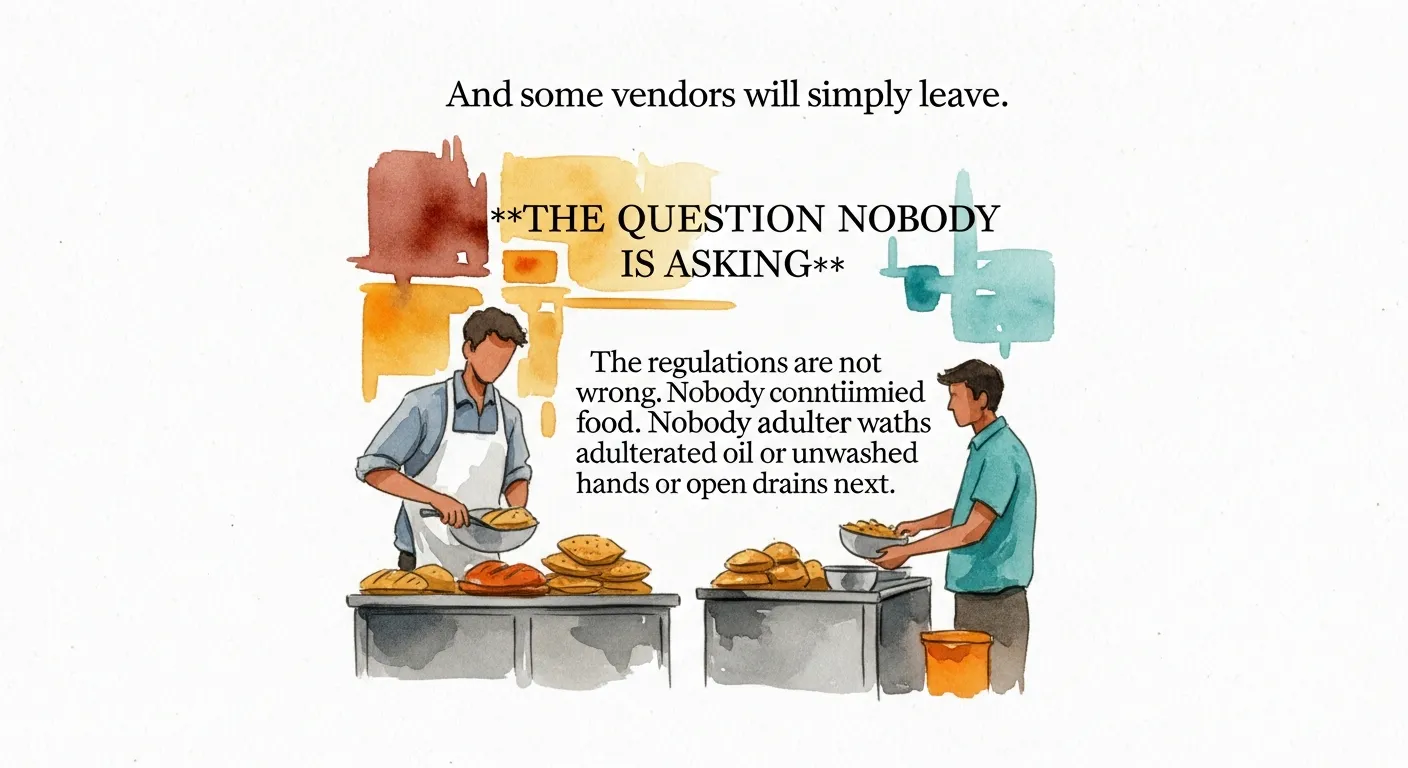
And some vendors will simply leave.
The pavement does not have a retirement plan.
THE QUESTION NOBODY IS ASKING
The regulations are not wrong. Nobody wants contaminated food. Nobody wants adulterated oil or unwashed hands or open drains next to open tawas. The FSSAI's mandate is public health, and public health is not negotiable.
But the question is not whether vendors should comply. The question is who pays for compliance when the vendor cannot. The 2026 amendments give street vendors deemed registration, which reduces one cost. They give perpetual licences, which reduces another. But they add audits, inspections, and infrastructure requirements that dwarf the savings.
The net effect is an increase. Not in paperwork. In money.
And when the economics of a pav bhaji stall shift, the economics of a neighbourhood shift with them. Tardeo's pavement food culture did not emerge from a policy document. It emerged from a city that needed cheap, fast, hot food at 11 PM on a Wednesday. That need has not changed. The cost of meeting it has.
In 1966, America decided that transparency was worth the price. Forty percent of its small producers disagreed, not in principle, but in practice. They closed.
The tawa is still hot in Tardeo. The question is how long the people behind it can afford to keep it that way.
Field Notes
Quick reference₹154.87 crore in fines collected by FSSAI in FY 2025-26 alone. The enforcement push is real.
Sardar Pav Bhaji has operated on Tardeo Road since 1971. The queue wraps past the signal on weekends.
FSSAI and BMC launched free food safety training for 10,000 Mumbai street vendors. Knowledge without subsidies.
Third-party audits cost the same whether you sell 100 plates or 1,000. Fixed costs hit small vendors hardest.
America's Fair Packaging Act killed 40% of small producers within a decade. Compliance costs don't scale down.
Get the next story first
Join the Bhukkads. Free, no spam, just stories.
Takes 30 seconds.