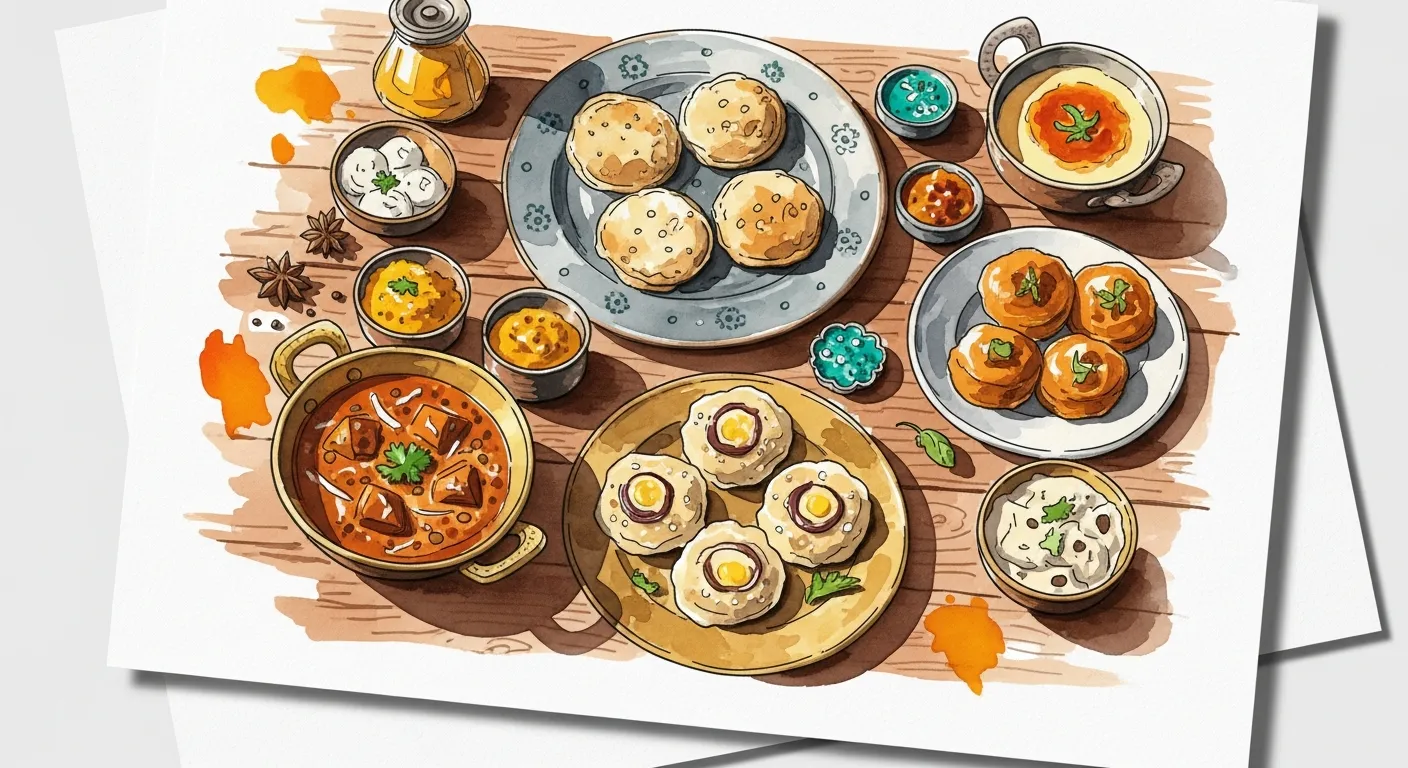
The Dabba Learned to Count Calories
Powai's tiffin economy was always run by women. The professionals just started paying what it was worth.
Generated by Imagen 4
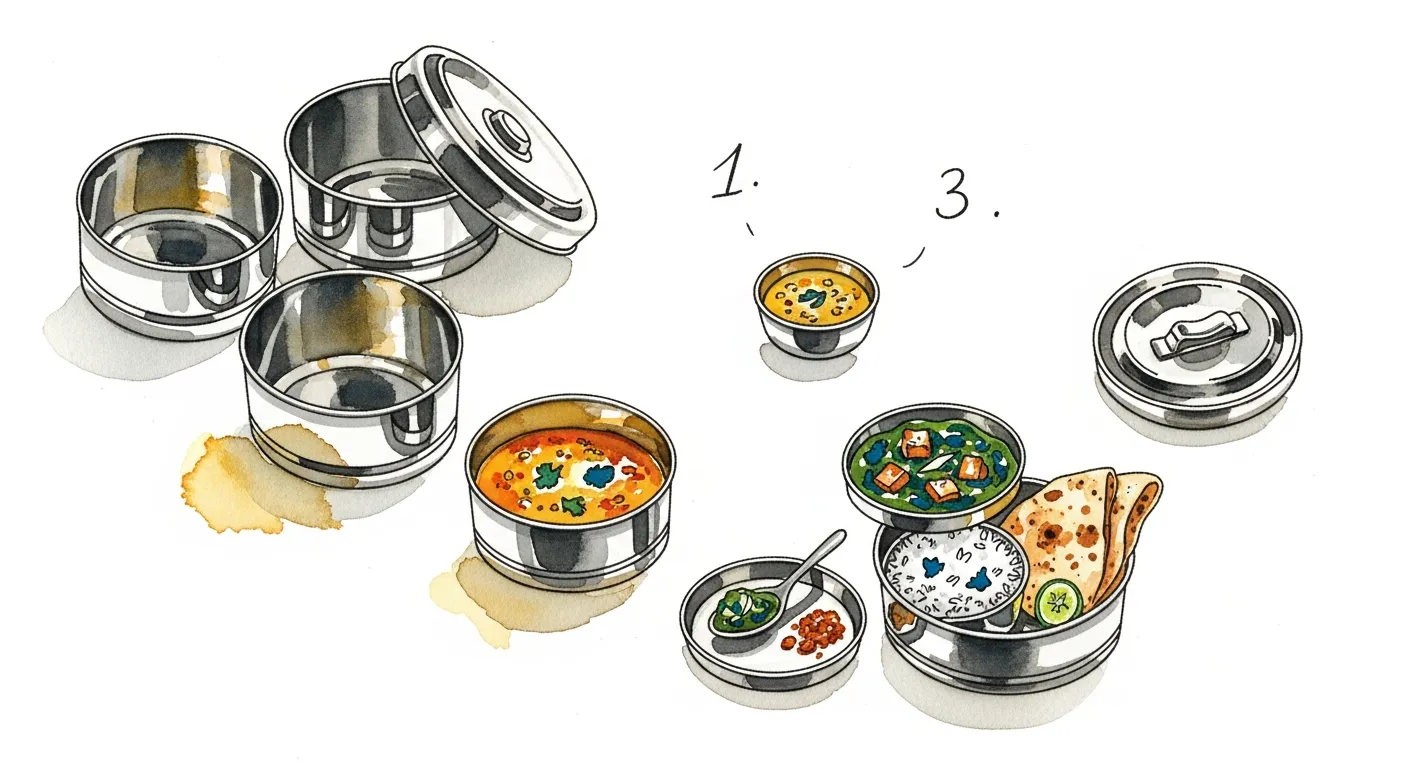
In 1890, a Parsi banker in Bombay hired a man named Mahadeo Havaji Bachche to solve a problem that was not, strictly speaking, his to solve. The banker worked in the Fort area. He lived in Girgaon. He wanted to eat his wife's cooking for lunch. The distance was about six kilometres. The solution, which would eventually employ 5,000 men and feed 200,000 office workers a day, was the dabbawala system. Mahadeo started with 100 men. The tiffin, a cylindrical steel stack of compartments, became the most recognisable unit of Bombay's lunch economy.
Nobody ever asked who cooked the food inside.
THE INVISIBLE HALF OF A FAMOUS SYSTEM
The dabbawala story is told, correctly, as a logistics marvel. Six Sigma certification. Harvard case studies. Prince Charles visiting in 2003. What the story almost never mentions is that every single one of those 200,000 tiffins was filled by a woman working in a kitchen at 9 AM for no wage, no recognition, and no business model. The husband ate. The dabbawala delivered. The wife cooked. That was the arrangement for 134 years.
The labour was always there. The market is new.
What has changed in Powai, and what is worth paying attention to, is that the kitchen is no longer an extension of the household. It is a business. The woman is no longer a wife first and a cook second. She is a chef with a customer list, a menu, and a bank account that is hers.
WHY POWAI, WHY NOW
Powai is a neighbourhood built by Hiranandani in the late 1980s and 1990s, on what was essentially marshland around a lake. The demographic it attracted was specific. IIT Bombay faculty. Mid-level IT workers. Finance professionals who did not want to live in Bandra but could not afford it anyway. The neighbourhood ages well because its residents age together. The 28-year-old coder who moved here in 2015 is now 38, married, possibly with a child, definitely with a lower back problem and a nutritionist telling him to cut down on oil.
This is the customer. This is why the tiffin service in Powai does not sound like the tiffin service your grandfather used.
Tiffit describes its offering in Powai Chandivali as meals "freshly cooked upon order, using high-quality ingredients, no preservatives, and minimal oil." That is not how Mahadeo's customers in 1890 talked about lunch. Lunch in 1890 was a lunch. Lunch in 2026 is a compliance document.
The kitchen is no longer an extension of the household. It is a business.
THE CORPORATE CAFETERIA IS LOSING
For about two decades, the default lunch for a professional in a Powai office tower was the in-house cafeteria run by a large contract caterer. Sodexo, Compass, a regional player. The economics worked for the employer because the employer subsidised part of the cost, the caterer took a margin on volume, and the employee got something resembling food for something resembling a reasonable price.
What broke the model was not price. It was calibration.
The corporate cafeteria cooks for 800 people. It cannot ask 800 people whether they want less oil today, more protein, no onion on Tuesdays, a Jain thali on Paryushan, a keto option because the gym trainer said so. It cooks a mean. The mean is getting rejected.
The women running tiffin operations out of Powai kitchens cook for 15 to 40 customers. They can ask. They do ask. Some of them send a WhatsApp message the night before. The cafeteria feeds a crowd. The home chef feeds a person.
THE KITCHENPRENEUR, NAMED
The word is ugly. The phenomenon is not. Tiffit calls it the Kitchenpreneur Revolution, a platform positioning itself as "a trusted platform for growth, recognition, and financial freedom." The pitch to women is unsentimental. "Women don't need to step out of their homes or make heavy investments. No risk is involved in registering yourself as a home chef at Tiffit."
Read that sentence twice. It is describing a labour market that already exists, that was always unpaid, and is now being formalised. The woman is not learning a new skill. She is being paid for the one she had.
FoodiaQ runs a Powai tiffin operation on the same logic. Skilled home chefs. Homestyle meals. A rotating weekly menu of 10 regional specialties. Monday is Maharashtrian, Wednesday is Bengali, Friday is South Indian. The customer gets variety. The chef gets to cook what she actually knows.
THE MONEY, SPECIFICALLY
This is where the story gets useful.
Hiring a full-time home cook in Powai, according to Helpers Near Me, costs between ₹12,074 and ₹13,008 a month in 2026. That is what a household pays one cook for dedicated service. A home chef running a tiffin operation for 20 customers at roughly ₹4,000 to ₹6,000 a month per tiffin is operating at a different scale entirely. The arithmetic is not complicated. It is just arithmetic that nobody in the family was doing until recently.
The shift is from wage labour to business ownership. From one employer to 20 customers. From a salary that ends when the employer moves cities to a client list that stays.
She is not learning a new skill. She is being paid for the one she had.
THE NUTRITIONIST IN THE KITCHEN
The newest layer is the dietitian. Across Mumbai, operations like Poonam Kapur's Healthy Tiffins have built businesses around personalised meal plan consultations, diet-conscious food, and a medical vocabulary that the corporate caterer simply does not have.
What the Powai professional wants for lunch in 2026 is not lunch. It is a macro count. 40 grams of protein, under 500 calories, low glycemic index, something the Fitbit approves of. The home chef who can produce this, consistently, for less than what the office cafeteria charges, has a business. The corporate caterer, cooking in 50-litre vessels, cannot match it.
The tiffin did not get smaller. It got smarter.
WHAT THE HUSBAND MISSED
The dabbawala in 1890 was solving for a banker who missed his wife's cooking. The tiffin service in 2026 is solving for a 38-year-old product manager who has never eaten his mother-in-law's cooking, lives in a flat where nobody has time to cook at 9 AM, and whose nutritionist has opinions about ghee.
The women who are building these businesses are not, for the most part, entering the workforce for the first time. Many of them left careers when they had children. Many have cooked for 15, 20, 25 years for families that never counted the labour. The platform, the FSSAI certification, the WhatsApp customer, the UPI payment, these are the infrastructure that turned that labour into income.
Helpers Near Me describes the broader shift with a sentence that should be printed on a wall somewhere: "With nuclear families and dual-income households becoming more common, the time available for regular cooking has reduced." Translation: the household cannot afford to not pay for cooking anymore. Someone is going to do it. Someone is going to be paid. The question is only who.
THE CATERER WHO NEVER SAW IT COMING
The big contract caterer runs on a simple assumption: that feeding 800 people at once is always cheaper per head than 40 people cooking for 20 each. That assumption was true when food was fuel. It is not true when food is a prescription.
A corporate caterer cannot afford to cook for one customer's gluten intolerance, another's PCOS, a third's intermittent fasting window. A home chef in Hiranandani Gardens can. She is already cooking for five people in her own household with five different requirements. Twenty more is a logistical upgrade, not a reinvention.
The catering contract that used to be renewed without question is now being re-negotiated. Some offices have dropped the in-house caterer entirely and just let employees expense their tiffin. That is the quiet part of this story. The company is no longer feeding you. It is subsidising whoever you chose to pay.
THE LOOP CLOSES
Mahadeo Havaji Bachche's dabbawalas are still running. 134 years in. The tiffins still move. What has changed is the kitchen at the start of the chain. It used to be anonymous, unpaid, and invisible. It is now a business with a brand name and a GST number.
The banker in 1890 wanted his wife's food at his desk. In 2026, the product manager wants a stranger's food at his desk, because the stranger is a better cook, a trained nutritionist, and his own wife is also at her desk ordering from someone else.
The dabba got there either way. The woman finally got paid.
Field Notes
Quick referenceMahadeo Havaji Bachche started the dabbawala system in 1890 with 100 men for one banker who missed his wife's cooking.
The dabbawala system today employs 5,000 men and feeds 200,000 office workers daily — all from women's unpaid kitchen labour.
A full-time cook costs ₹12,074-₹13,008/month. A tiffin business serves 20 customers at ₹4,000-₹6,000 each.
Built by Hiranandani on marshland in the 1990s for IT workers and IIT faculty — a demographic that ages together.
Some offices dropped in-house caterers entirely and now subsidise employees' tiffin choices.
Get the next story first
Join the Bhukkads. Free, no spam, just stories.
Takes 30 seconds.