The Dock Was Here Before the City
Sassoon Dock's Koli fishers aren't fighting for a market. They're fighting for the last proof that Mumbai was theirs first.
Generated by Imagen 4
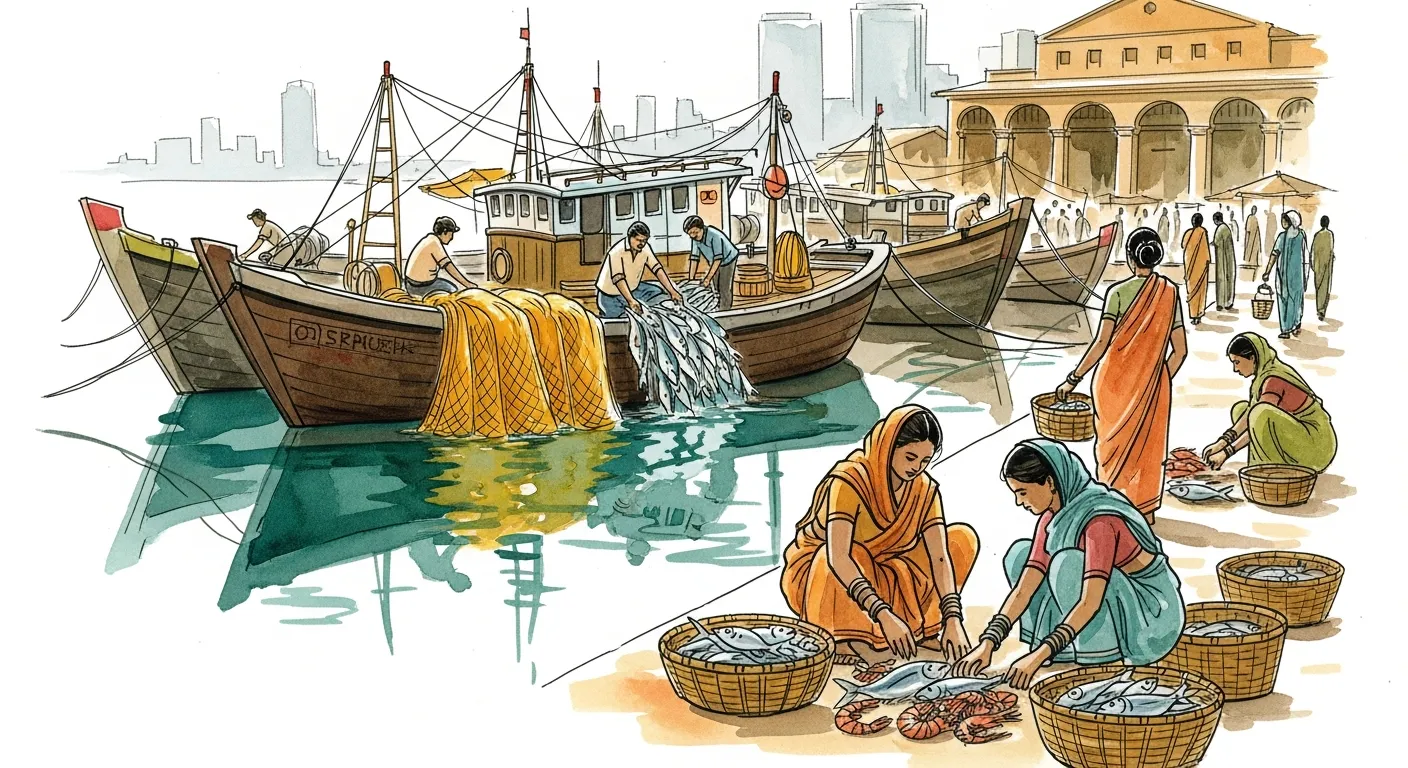
In 1662, the Portuguese Crown handed seven islands to Charles II of England as part of a dowry. Catherine of Braganza was marrying into the House of Stuart, and Bombay was the price. Nobody asked the people already living there. Nobody needed to. The Kolis had been fishing these waters for over a thousand years before the Portuguese ever showed up, before the Mughals consolidated the Konkan, before anyone thought to call this archipelago a city. The Koli people are not from Mumbai. Mumbai is from the Koli people. The city's name, most historians agree, derives from Mumbadevi, the goddess the Kolis worshipped. Their boats were here before the reclamation, before the railways, before the cotton mills, before the Coastal Road.
They are still here. Barely.
THE DOCK THAT BUILT THE TRADE
Sassoon Dock was built in 1875, financed by Albert Abdullah David Sassoon, a Baghdadi Jewish businessman whose family had already transformed Bombay's textile and opium trades. It was the city's first wet dock, carved into the Colaba waterfront at a time when the fish trade ran on wooden jetties and faith in the tide. The dock gave the Koli fishers something they had never had: infrastructure. A stone landing. A permanent market. A fixed point in a city that was just beginning to understand itself as a city.
For 150 years, Sassoon Dock functioned as Mumbai's primary fish landing site. Boats came in before dawn. Women, almost all of them Koli, sorted the catch on the wet stone floor, separated the pomfret from the rawas, the bombil from the surmai. Buyers from hotels, restaurants, and wholesale markets arrived by 5 AM. The entire economy of Mumbai's fish supply ran through a single dock in Colaba.
That economy is now being strangled from three directions simultaneously.
THE FUEL THAT STAYED ON SHORE

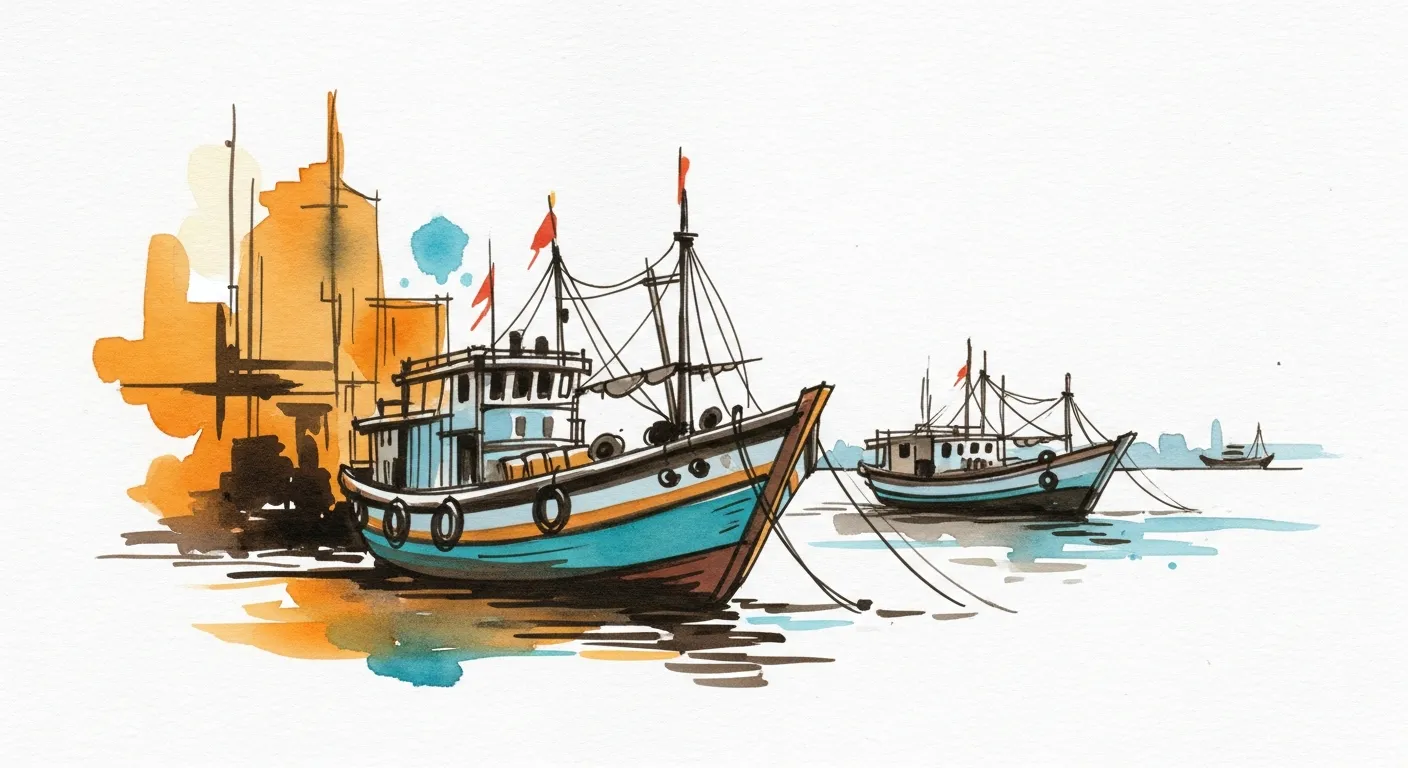
The most immediate crisis is diesel. Fishing trawlers run on it, and the cost has surged beyond $1.20 per litre, a figure that makes a single deep-sea trip economically suicidal for small-boat operators. Al Jazeera documented the result earlier this year: boats sitting idle at Sassoon Dock, hulls gathering barnacles, fishers sitting on the jetty with nothing to haul. Incomes have plummeted. A community that once measured its wealth in catch weight now measures it in fuel cost.
The boats are not broken. They are simply too expensive to start.
This is not a Mumbai problem alone. It cascades across the Konkan coast, hitting every fishing village from Versova to Ratnagiri. But at Sassoon Dock, the fuel crisis collides with something worse: the systematic disassembly of the market itself.
THE BAN NOBODY EXPECTED
Every monsoon, the Maharashtra government enforces a fishing ban along the coast, roughly from June through August. The Kolis have lived with this for decades. It is seasonal, predictable, and ecologically justified.
What came recently was none of those things. The Maharashtra state fisheries department imposed a ban on fish sales at Sassoon Docks that went beyond the usual monsoon restriction. This one did not just stop boats from going out. It stopped fish from being sold, period. Even stored fish. Even inland-sourced fish. The distinction matters enormously.
Over 500 Koli women lost their daily income overnight.
These are not trawler owners. These are the women who arrive at 4 AM, who sort, clean, and retail fish from the wet floor of the dock. Hundreds of traditional fishers were affected alongside them. The ban treated the dock not as a living market but as a site to be managed, a problem to be administered.
THE COURT, THE SMELL, THE ARGUMENT
The ban did not arrive in a vacuum. It followed a Bombay High Court directive addressing complaints from Colaba residents about foul smell and unhygienic conditions at the dock. A Public Interest Litigation had been filed. The court's position was clear: fishermen's livelihoods cannot create a public nuisance.
Think about that sentence for a moment. A 150-year-old fish market, predating every apartment building within a two-kilometre radius, is being told it smells bad by people who moved in next to a fish market.
The dock was not built near the residences. The residences were built near the dock.
The Mumbai Port Authority, which controls the land, has taken the position that retail vending at the dock is not permitted, an interpretation the Koli community disputes with 150 years of continuous use as their evidence. The High Court's intervention, however well-intentioned on sanitation grounds, has given administrative cover to those who want the dock cleaned up, thinned out, and eventually repurposed.
NOBODY TALKS ABOUT THE GODOWNS
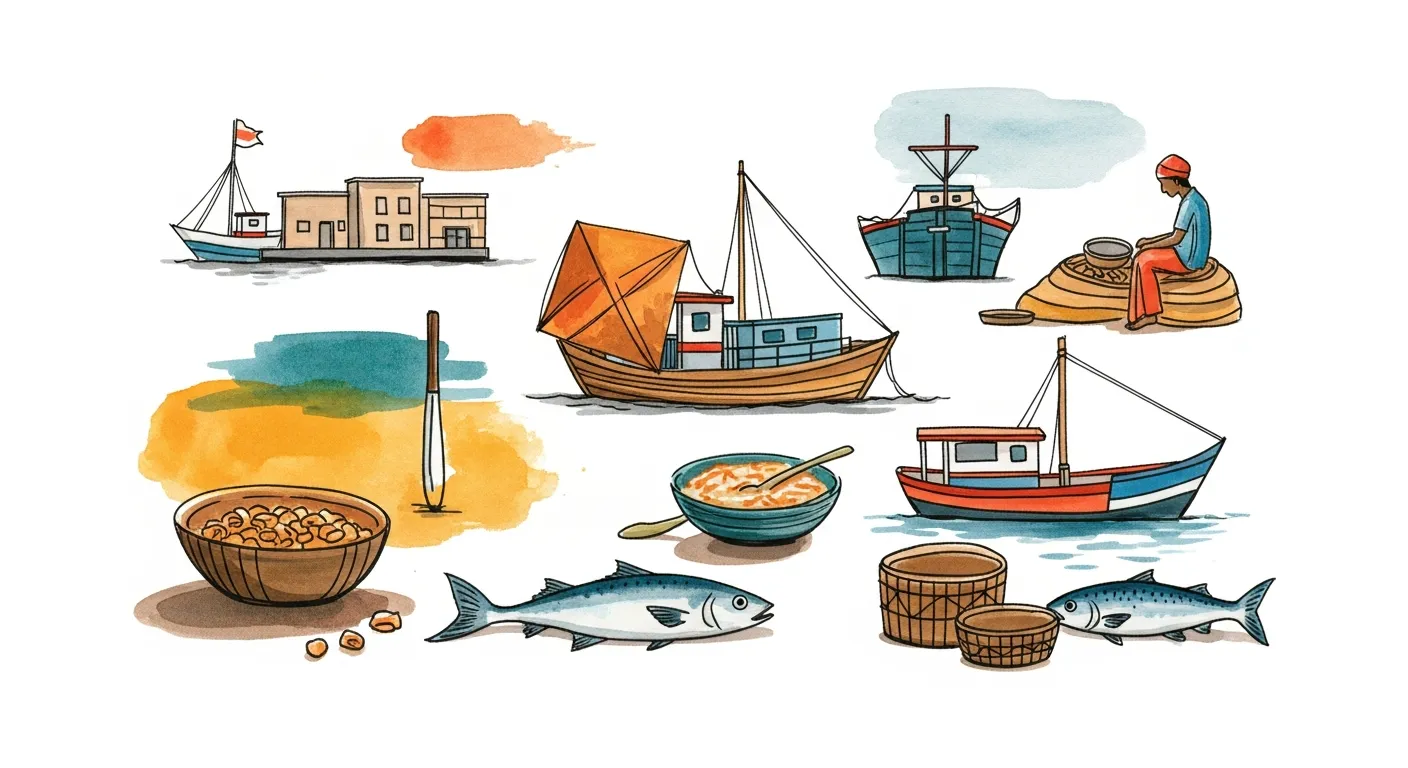
Here is the thing nobody outside the fishing community discusses. The physical infrastructure of the Koli trade at Sassoon Dock does not just mean the landing jetty. It means the godowns, the storage sheds where ice is kept, where fish is held for wholesale distribution, where nets and equipment are stored between seasons. These godowns are the logistical backbone of the entire operation.
The Mumbai Port Authority has been clearing these disputed godowns, claiming the structures encroach on port land. For the fishers, this is not a land dispute. It is an erasure. Without storage, there is no wholesale. Without wholesale, there is no reason for boats to land at Sassoon Dock at all. The dock becomes a heritage site, a photo opportunity, a promenade.
Take away the godowns and you have not cleaned a dock. You have killed a supply chain.
The redevelopment pressures are well documented. Shrinking fishing zones. Creeks choked by coastal reclamation. Falling fish yields driven by pollution, construction sediment, and habitat destruction. The Koli community sees a pattern that is not accidental: first the fishing zones shrink, then the fuel costs rise, then the godowns are cleared, then the court says the smell must go, then the sales ban arrives. Each step has its own logic. Together they form a single direction.
THE SHORELINE THAT MOVED
Mumbai's coastline is not what it was even 20 years ago. The Coastal Road, the Bandra-Worli Sea Link before it, the reclamation at Nariman Point decades before that, each project pushed the water further from the places where the Koli traditionally launched. The changing shoreline is not a metaphor. It is a measurable reality. Fishing zones that were accessible from shore now require longer trips, more fuel, more time, and less certainty of return.
The marine ecosystem itself is shifting. Overfishing by industrial trawlers (not the Koli, whose boats are smaller and whose methods are older) has depleted near-shore stocks. Pollution from the Mithi River and from construction runoff has degraded breeding grounds. The fish are fewer, further away, and harder to catch. For a community that fishes from boats powered by diesel they can barely afford, these are not abstract environmental concerns. They are the difference between eating and not eating.

The sea is not empty. It has just been pushed beyond the reach of the people who knew it first.
WHAT REMAINS
The Koli community has survived the Portuguese, the British, the post-Independence port trusts, and 150 years of reclamation. They have survived because they adapted. They moved from canoes to motorised trawlers. They moved from barter to wholesale markets. They built cold chains before the city had a word for logistics. Their women became the retail backbone of Mumbai's fish economy, running a distribution network that has never depended on apps or venture capital or temperature-controlled trucks.
But adaptation requires something to adapt to. When the dock is restricted, the godowns cleared, the fuel unaffordable, and the court sympathetic to the neighbours rather than the workers, what remains is not a community in transition. It is a community being managed out of existence.
The Kolis did not come to Mumbai for opportunity. Mumbai came to them and called it progress.
The Sassoon Dock Art Project in 2017 brought installations and international attention to the space. The fisherwomen worked around the art. The art left. The fisherwomen stayed. Or tried to.
A dock is not heritage if the people who use it are still alive and working. It is a workplace. Call it what it is.
1875
Albert Sassoon built the dock because the fish trade needed stone under its feet. That was the entire logic. A place for boats to land and women to sell. One hundred and fifty years later, the boats cannot afford to leave, the women are banned from selling, the godowns are rubble, and the neighbours have complained about the smell.
The dock is still there. It was there before the city had a name.
Field Notes
Quick referenceDiesel costs have surged beyond $1.20 per litre, making deep-sea fishing trips economically impossible for small-boat operators.
Over 500 Koli women lost their daily income when Maharashtra imposed a sudden fish sales ban at Sassoon Dock.
Sassoon Dock was built in 1875, predating every apartment building within a two-kilometre radius.
Mumbai Port Authority has been clearing godowns that are the logistical backbone of the fishing operation.
Kolis had been fishing these waters for over a thousand years before the Portuguese arrived.
Get the next story first
Join the Bhukkads. Free, no spam, just stories.
Takes 30 seconds.