The Sandwich That Used to Cost Twenty Rupees
Churchgate's grilled sandwich was the city's most honest lunch. Then the cylinder went to three thousand rupees.
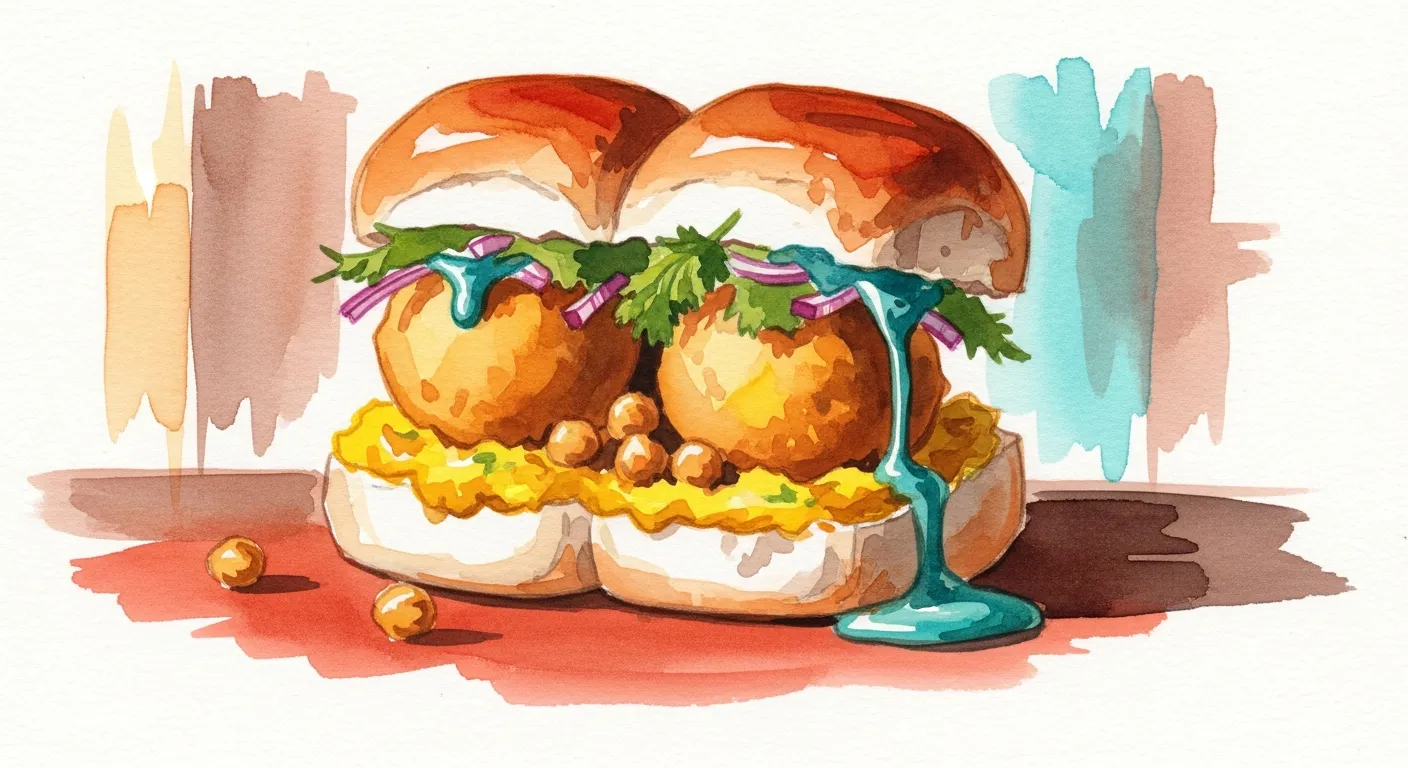
Generated by Imagen 4
In 1933, a man named Achyut Balwant Lawate started selling something he had eaten in a Bombay college canteen and could not stop thinking about. Two slices of white bread, a layer of green chutney made of coriander and mint and green chillies, a few rounds of boiled potato, a slice of tomato, a slice of cucumber, a slice of onion, a slice of boiled beetroot if you were feeling festive, salt, chaat masala, butter on the outside, pressed in a hand-cranked toaster over a coal sigri until the bread went the colour of old teak.
That was it. That was the Bombay sandwich. No cheese. No grill marks. No imagination. The whole thing cost four annas.
Ninety-three years later, the sandwich is still on the pavement outside Churchgate station, outside Flora Fountain, outside every entrance to every office building between Fort and Nariman Point. The recipe has not moved. The chutney is still green. The beetroot is still suspicious.
The price has moved. The price has moved a lot.
THE LUNCH THAT BUILT THE OFFICE DISTRICT
The grilled sandwich did not become Mumbai's office lunch by accident. It became Mumbai's office lunch because of geography.
Fort and Churchgate, by the 1960s, held the highest density of white-collar jobs in the country. Banks on Bombay Samachar Marg. Insurance offices around Flora Fountain. Brokers at Dalal Street. Newspaper offices on D N Road. Government clerks at the BMC headquarters. A few lakh men, mostly, walking in from Churchgate and CST every morning at nine, walking back at six.
They needed lunch. They had thirty minutes. They had twenty rupees.
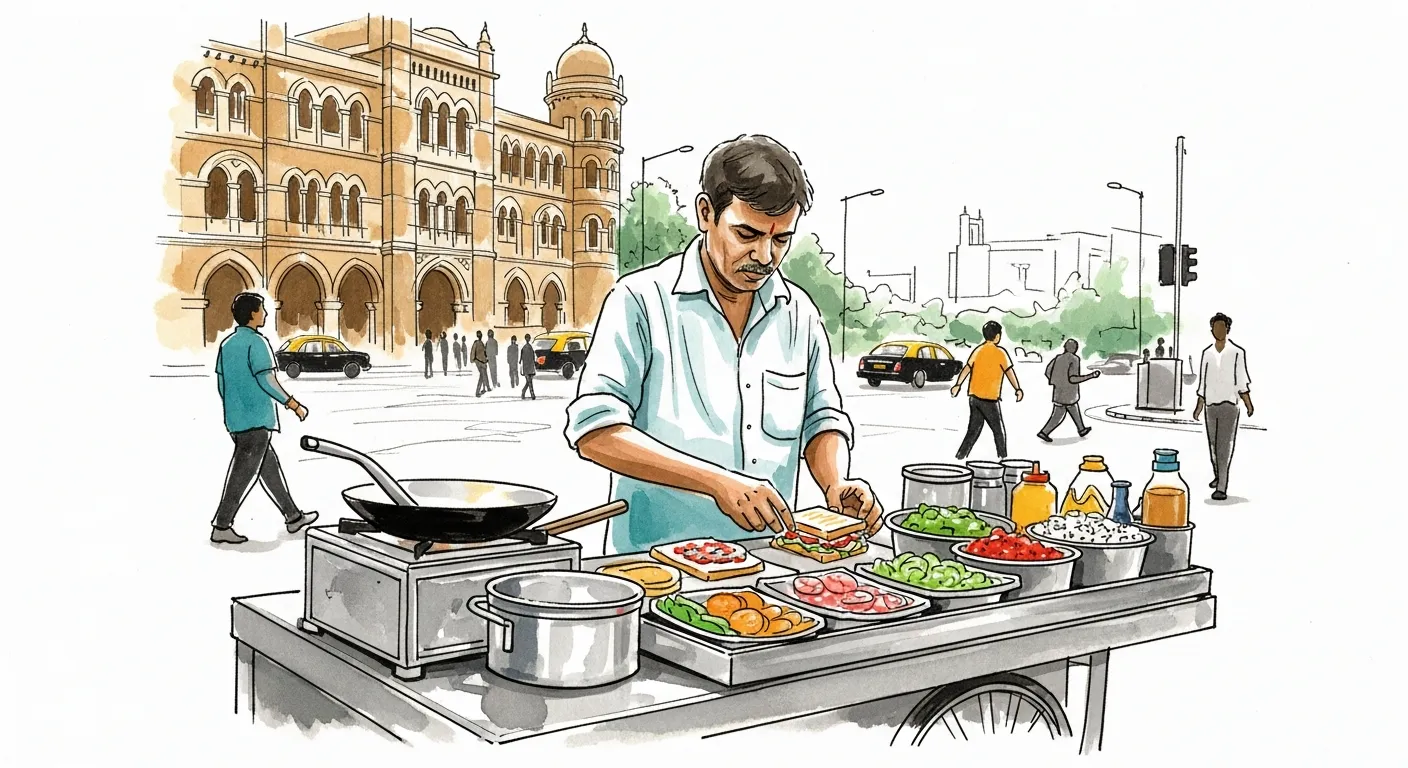
The sandwichwala showed up with a folding table, a Nutan stove, a hand-cranked toaster, and four loaves of Wibs bread. He set up outside the office gate. He took the order. He layered the chutney, sliced the vegetables on a wooden board worn concave from twenty years of the same knife, buttered the bread, clamped the toaster, held it over the flame for ninety seconds a side. He served it on a square of newspaper with a smear of extra chutney and a wedge of lime.
Twenty rupees. Two slices, three vegetables, one chutney, one smile. The most honest transaction in the city.
The sandwichwala was never selling food. He was selling the half-hour between two meetings.
THE CYLINDER
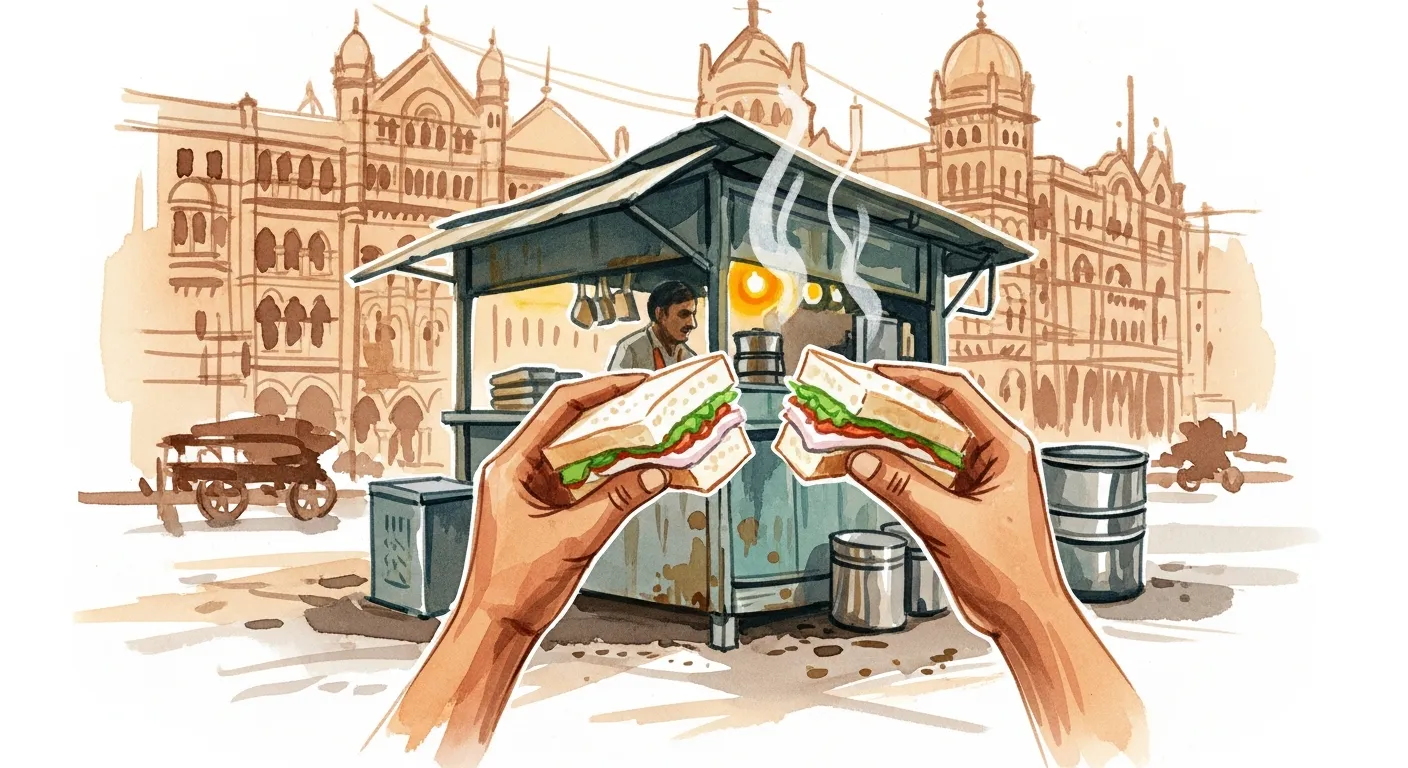
On May 1, 2026, the commercial LPG cylinder in Mumbai went up by 933 rupees in a single morning. A 19-kilogram cylinder, which is what every sandwichwala and chaiwala and vada pavwala in Fort uses, now costs roughly 3,024 rupees.
A sandwichwala goes through one cylinder every eight to ten days, depending on footfall. That is an extra 2,500 to 3,000 rupees a month on fuel alone. On a stall that nets between 20,000 and 30,000 rupees a month after raw material, that is not a line item. That is the rent.
The Indian Express went and stood outside a sandwich stall in Nariman Point in May 2026 and found a vendor who had moved his sandwich from twenty rupees to thirty. A fifty percent increase, overnight. He told the reporter his daily customer count had dropped by roughly thirty percent.
The math is brutal. He raised the price by fifty percent and lost thirty percent of his customers. He is making less money on a more expensive sandwich than he was making on the cheaper one.
THE BREAD, THE TOMATO, THE BUTTER
The cylinder is only the loudest number. The quieter ones are worse.
A 400-gram loaf of sandwich bread in Mumbai, the standard Wibs or Britannia square that every sandwichwala uses, went from 40 rupees to 45 rupees this year. A loaf gives you roughly six sandwiches. That is just under one rupee extra per sandwich, on the bread alone.
"Bread prices have risen by up to Rs 5 per packet across Mumbai and nearby areas," the Free Press Journal reported, and added that "local bakery owners said they, too, are struggling to absorb the rising costs of packaging materials, fuel and logistics."
Nobody absorbs anything in this city. The cost gets handed to the next person in the chain until it reaches the man with the folding table outside Churchgate station, and then it stops, because there is nobody after him.
Then there is the tomato. The Hindustan Times tracked vegetable prices across the Mumbai Metropolitan Region through the heatwave and found tomatoes had doubled to 50-60 rupees a kilo. French beans hit 200 rupees a kilo. The whole vegetable basket up by roughly fifty percent since early May.
A Bombay sandwich is, structurally, a tomato delivery system. You take the tomato out and it is two slices of bread with chutney.
NOBODY TALKS ABOUT THE PORTION
The price went up. Everyone wrote about the price.
Nobody talks about what happened to the sandwich.
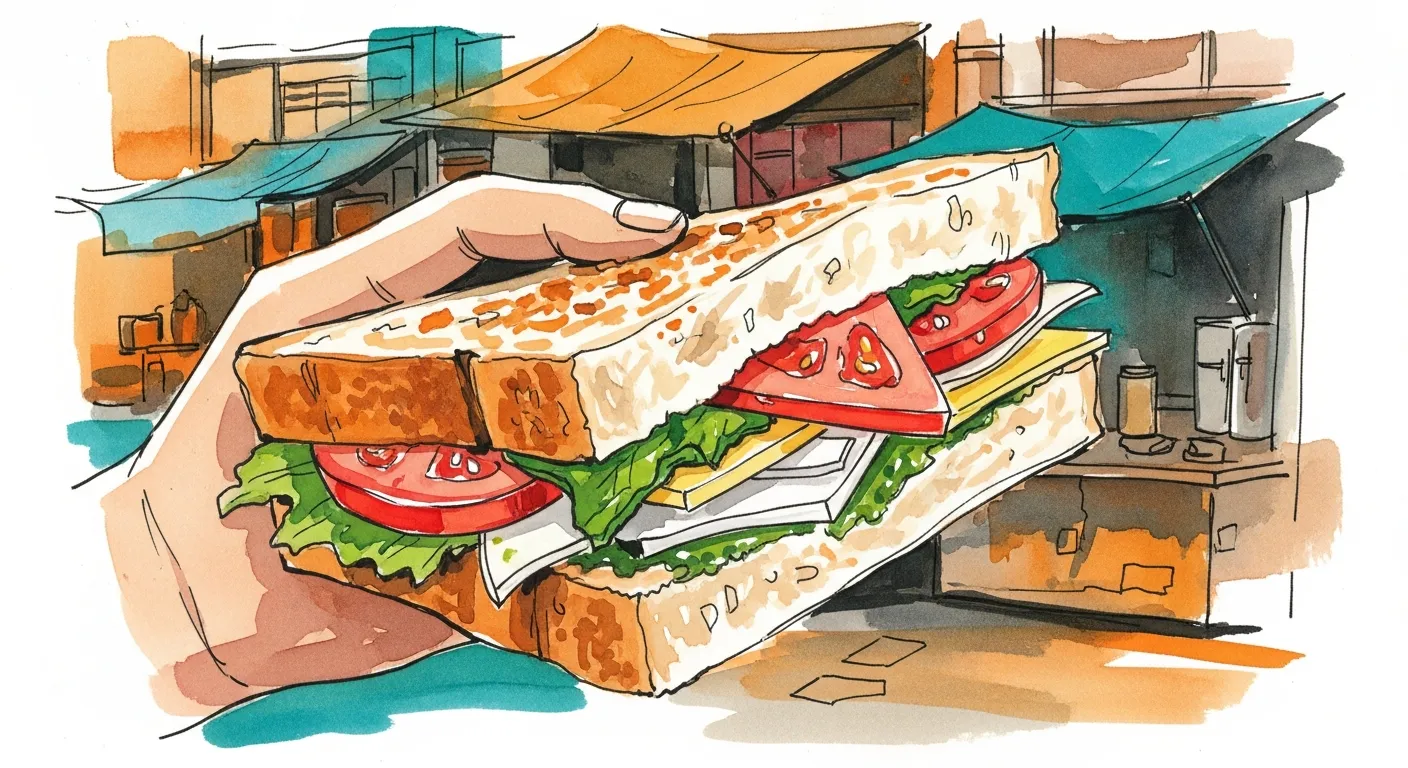
Stand at a stall in Fort today and watch the knife. The tomato slice is thinner. There used to be two. Now there is one, cut diagonally and arranged to look like two. The cucumber is thinner. The potato is thinner. The beetroot, which was always a flourish, has quietly disappeared from half the stalls in the district. The butter is being applied with a brush instead of a knife.
The sandwich is the same price as last month. It is not the same sandwich.
This is how a Bombay institution adjusts. Not by changing the menu. By changing the millimetres.
The regulars notice. The regulars always notice. They have been eating the same sandwich at the same stall for fifteen years. They know exactly how thick the tomato should be. They say nothing, because they also know what a cylinder costs.
The price stayed the same. The sandwich got quieter.
THE AFFORDABILITY MYTH
For seventy years, Mumbai street food has been sold to the world on a single promise. It is cheap. It is good. It is everywhere.
Two of those three are still true.
India Today, writing in May 2026, pointed out what every office-goer in Fort already knows. Street food in metros is no longer the budget option. Rent on a pavement license, fuel on the cylinder, labour for the assistant who chops the onions, transport from the wholesale market at Byculla, everything has climbed at the same time, and the customer who used to spend twenty rupees on lunch now spends fifty, and the customer who used to spend fifty now packs a dabba from home.
The sandwich at thirty rupees is still cheaper than anything in any cafe in any building it sits outside. The Pret on the ground floor of a Nariman Point tower sells a sandwich for 380 rupees. The sandwichwala on the pavement outside that same tower sells one for thirty. The ratio has not collapsed. The floor has just risen.
What has collapsed is the idea that the pavement sandwich is loose change. It used to be the thing you bought without thinking. Now you think about it. You count out three tens instead of handing over a twenty and walking away.
THE MEN WHO ARE STILL STANDING
There is a sandwichwala outside a building on Veer Nariman Road who has been at the same spot since 1991. He came from Sangli when he was nineteen. He learned the chutney from a man who learned it from a man who learned it in 1958.
He has not raised his price to thirty. He is still at twenty-five. He told a customer last week that he will hold it at twenty-five until Diwali, and then he will see. He has a son in the eleventh standard. The fees were paid in April.
There is another sandwichwala near Flora Fountain who has started selling a smaller sandwich, a half-cut, for fifteen rupees. Three vegetables instead of five. One chutney. No grill. Just toasted on the tawa. He calls it the cutting sandwich. The office boys who used to buy a full one now buy two of these and share.
The form is adjusting. The man is still standing.
THE LUNCH HOUR
Go to Churchgate at 1:15 on a Wednesday. The trains have stopped pouring out. The footpath outside the station is two-deep at every stall. The hand-cranked toasters are clicking. The chutney is being spread. The newspaper squares are being folded.
The sandwich costs thirty rupees now. The tomato is thinner. The beetroot may or may not show up. The man at the table has worked out, on the back of a calendar, that he needs to sell ninety sandwiches a day to break even, and he sold seventy-two yesterday.
He will be here tomorrow. He will be here on Friday. He will be here in November when the cylinder goes up again, because it always does.
The sandwich used to cost twenty rupees. Now it costs thirty. The lunch hour has not moved. The half-hour between two meetings still needs to be filled.
He is still the one filling it.
Field Notes
Quick referenceCommercial LPG in Mumbai rose by 933 rupees in a single morning on May 1, 2026. One cylinder now costs roughly 3,024 rupees.
Pret at Nariman Point: 380 rupees a sandwich. The pavement outside: 30 rupees. The gap is still there. The floor just moved.
A sandwichwala raised prices 50% and lost 30% of customers. He is netting less than before the hike.
Near Flora Fountain, one vendor now sells a half-cut for 15 rupees. Three vegetables, one chutney, tawa only. Office boys buy two and share.
A 400-gram loaf of Wibs or Britannia sandwich bread rose from 40 to 45 rupees this year. Six sandwiches per loaf. Under one rupee extra each, on bread alone.
Get the next story first
Join the Bhukkads. Free, no spam, just stories.
Takes 30 seconds.